Pakistan and China have launched the China-Pakistan Information Corridor (CPIC) to counter misleading narratives, expand cultural exchanges, and enhance cooperation between think tanks. The initiative, announced by Information Minister Ataullah Tarar in Islamabad alongside Chinese officials, aims to connect public understanding through a four-pillar collaborative framework.
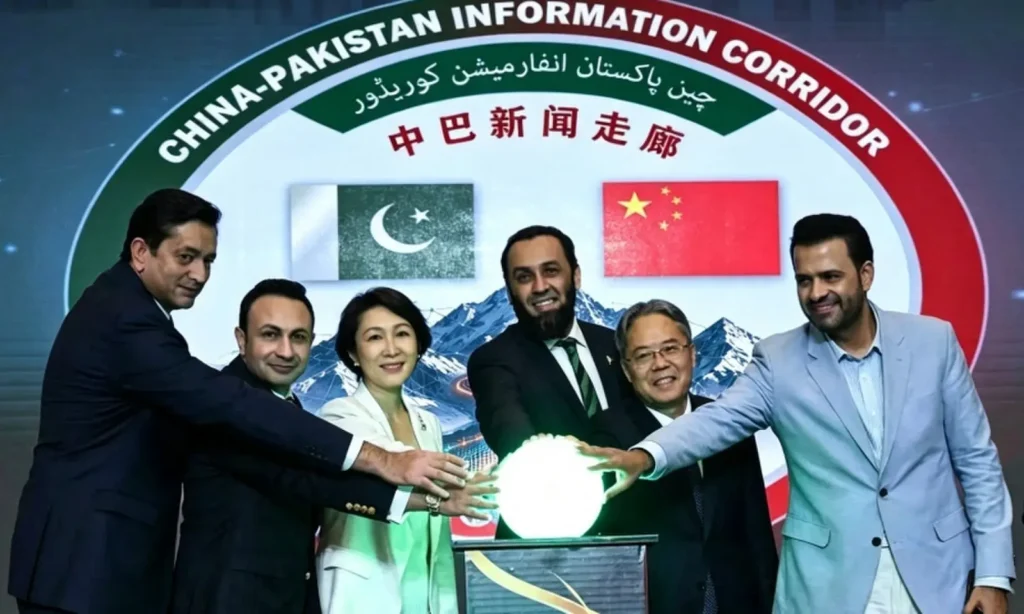
ISLAMABAD, October 27, 2026: Pakistan and China have officially launched the China-Pakistan Information Corridor (CPIC), a major bilateral initiative designed to counter misleading narratives, foster cultural exchanges, and strengthen institutional cooperation between think tanks and media organizations from both nations. The formal launch took place during a televised ceremony in Islamabad, attended by Pakistan’s Information Minister Ataullah Tarar, Chinese Foreign Ministry Spokesperson Mao Ning, and Chinese Ambassador to Pakistan Jiang Zaidong.
Addressing the gathering, Information Minister Ataullah Tarar stated that the newly unveiled corridor represents a vital extension of bilateral cooperation, building directly upon the foundational infrastructure projects established under the China-Pakistan Economic Corridor (CPEC). Tarar noted that while the initial phase of CPEC successfully connected physical geographies through roads, energy grids, and port infrastructure, the newly introduced information corridor is intended to bridge public perceptions and connect the minds of citizens in both countries.
Recalling the strategic trajectory of bilateral ties, Tarar remarked that previous cooperative milestones had translated decades of mutual goodwill into tangible assets such as steel, concrete, and electrical power. He emphasized that the newly launched initiative will operate across four foundational pillars: media partnerships, business and enterprise networking, think-tank collaborations, and cultural and tourism exchanges.
According to official outlines presented at the ceremony, the media pillar incorporates a dedicated news exchange working group comprising 18 prominent Pakistani and Chinese media organizations. Participating outlets range from national state broadcasters and private networks to major Chinese agencies including Xinhua, China Media Group (CMG), and People’s Daily. This cooperative framework features a dedicated fact-checking mechanism specifically established to track disinformation, debunk false reporting, and counter misleading narratives utilizing verified data and facts.
Countering Disinformation via the China-Pakistan Information Corridor
The second pillar focuses heavily on commercial cooperation, drawing participation from leading business groups and enterprises in both nations. Minister Tarar announced that this commercial branch has already established its inaugural regional office in Karachi. Furthermore, the initiative encompasses a specialized digital trade portal designed to monitor bilateral trade flows, investment metrics, and Foreign Direct Investment (FDI). It will also feature a dedicated podcast series documenting the real-world experiences of Chinese entrepreneurs operating within Pakistan and Pakistani business figures working in China.
The third pillar establishes institutional cooperation between leading research institutions and policy think tanks. Led domestically by the Pakistan-China Institute and supported by premier national research organizations, this segment aims to introduce deeper analytical depth and evidence-based insights to bilateral discourse. Activities will include joint dialogues, collaborative research initiatives, and coordinated publications alongside participating Chinese academic and research counterparts.
The fourth pillar centers extensively on tourism and people-to-people connectivity, which Tarar characterized as the emotional core of the initiative. Work is already underway on the Xinjiang-Gilgit-Baltistan tourism corridor, intended to facilitate travel extensions for Chinese visitors exploring northern Pakistan. Additionally, the government has nominated the inaugural cohort of CPEC Youth Ambassadors, selected from 13 universities across Pakistan to foster academic and cultural engagement among the younger generation.
Emphasizing the long-term vision of the project, Tarar stated that a shared community future must be rooted in mutual comprehension before being built in infrastructure. He asserted that if CPEC serves as the economic body of bilateral relations, the information corridor will function as its voice, replacing outdated caricatures with contemporary realities for citizens in both countries.

Khalid Minhas | Editor, Diplomatic Wire
A veteran journalist with three decades of comprehensive experience, Khalid Minhas has covered politics and international relations in depth throughout his career. He has also contributed to academia, teaching journalism and mass communication as a visiting faculty member at various universities in Pakistan. He holds an M.Phil in Mass Communication and is currently a Ph.D research scholar pursuing advanced studies in the field. He is also the author of the book America, Israel aur Islam, providing insightful analysis on the subject.