President Asif Ali Zardari met with Foreign Secretary Asim Iftikhar Ahmad at Aiwan-e-Sadr in Islamabad, stressing the importance of expanding international ties and promoting diplomatic engagement. This reader-focused report details the high-level diplomatic meeting, policy directives, and Pakistan’s ongoing global outreach objectives.
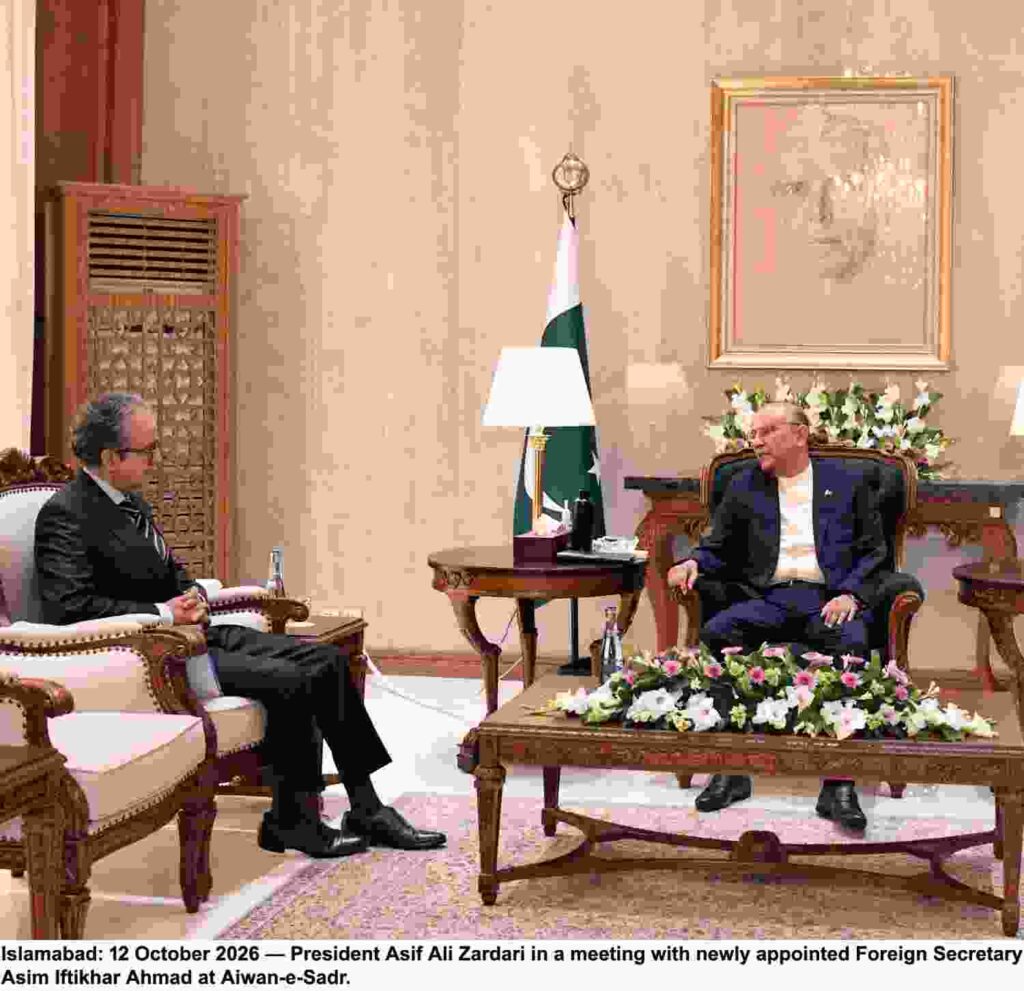
ISLAMABAD, October 12: Foreign Secretary Ambassador Asim Iftikhar Ahmad called on President Asif Ali Zardari at Aiwan-e-Sadr in Islamabad on Monday to discuss key diplomatic priorities and international affairs.
During the high-level meeting, President Zardari extended formal congratulations to Ambassador Asim Iftikhar Ahmad on assuming his new diplomatic assignment. The President expressed full confidence that the newly appointed Foreign Secretary would leverage his extensive diplomatic experience and professional commitment to effectively advance Pakistan’s vital foreign policy interests across the international arena.
Read also: Asim Iftikhar Ahmad Concludes UN Tenure as Pakistan PR
The official interaction underscored the country’s commitment to maintaining active communication channels with global partners, international organizations, and bilateral allies. Presidential directives highlighted the necessity of enhancing diplomatic engagement to address evolving regional and global geopolitical challenges.
President Zardari emphasised the fundamental importance of strengthening Pakistan’s bilateral and multilateral relations with countries around the world. He noted that proactive diplomatic outreach remains essential for securing national interests, fostering regional stability, and projecting a constructive image of the country abroad.
Furthermore, the President underscored the need for promoting robust, constructive diplomatic engagement across multiple multilateral platforms. He pointed out that constructive dialogue and proactive participation in international forums are critical for addressing contemporary global challenges, ranging from economic cooperation to regional security and developmental diplomacy.
Advancing mutually beneficial cooperation emerged as another central theme during the discussions at the presidential residence. President Zardari stressed that Pakistan’s foreign missions and diplomatic apparatus must prioritize economic diplomacy, trade facilitation, and strategic partnerships that yield tangible mutual benefits for Pakistan and its international partners.
The meeting also touched upon broader regional dynamics and diplomatic strategies aimed at deepening ties with key strategic allies and friendly nations. Officials reviewed current diplomatic initiatives and ongoing engagements across various global capitals.
Concluding the meeting, President Zardari offered his best wishes to Foreign Secretary Asim Iftikhar Ahmad, wishing him complete success in the discharge of his official responsibilities during his tenure at the Ministry of Foreign Affairs.
Foreign Policy Priorities and Diplomatic Engagement
The diplomatic engagement between the head of state and the nation’s top career diplomat reflects the ongoing alignment within Pakistan’s foreign service machinery. Asim Iftikhar Ahmad brings a wealth of multilateral and bilateral diplomatic experience to his current role at the Ministry of Foreign Affairs. His previous diplomatic assignments include serving as Pakistan’s Permanent Representative to the United Nations, where he managed complex multilateral negotiations and represented national positions on critical international security, human rights, and sustainable development issues.
Observers note that the directives issued by President Zardari align closely with Islamabad’s broader strategic pivot toward economic diplomacy. In recent months, the Foreign Ministry has intensified its focus on attracting foreign direct investment, expanding export markets, and strengthening institutional ties with regional and global economic blocks.
Diplomatic analysts suggest that effective implementation of these foreign policy objectives requires robust coordination between civilian leadership, the Foreign Ministry, and overseas diplomatic missions. The government has increasingly emphasized the strategic role of Pakistani ambassadors stationed abroad in promoting trade, tourism, and diaspora welfare.
The interaction at Aiwan-e-Sadr also highlights the continuous administrative coordination required to navigate complex geopolitical landscapes in South Asia and beyond. As diplomatic channels remain vital for conflict prevention and cooperative security, the leadership’s emphasis on constructive engagement signals a steady adherence to multilateral norms and international law.
Ministry officials are expected to follow up on the presidential directives by formulating targeted diplomatic strategies for key regions, including the Middle East, Europe, Central Asia, and North America. Particular emphasis is placed on maintaining balanced relationships with major global powers while safeguarding core national sovereignty and security interests.
As Pakistan continues to address various diplomatic and economic hurdles, the Ministry of Foreign Affairs remains at the forefront of executing state policy. The leadership’s stated commitment to mutually beneficial cooperation is expected to guide upcoming bilateral dialogues, upcoming international summits, and ongoing multilateral negotiations involving Pakistan.

The Diplomatic Wire Desk is the institutional news and analysis body of Diplomatic Wire, overseen by Founder and Editor Khalid Minhas. The Desk covers international relations, foreign policy, and critical diplomatic initiatives with objective, timely reporting for a professional readership.