Pakistan and Brazil elevate military cooperation following high-level security talks in Rawalpindi between Field Marshal Asim Munir and Admiral Freire.
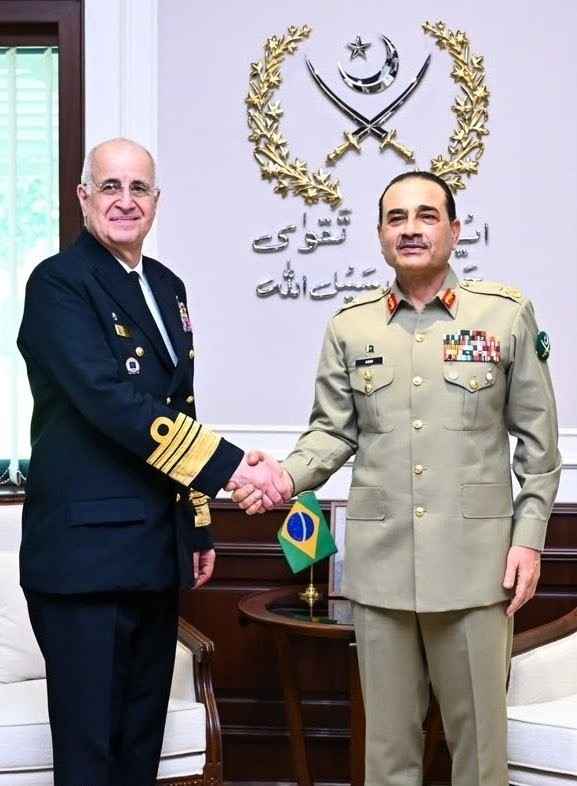
RAWALPINDI, October 12, 2026: Pakistan and Brazil have formally agreed to elevate their military-to-military cooperation following a high-level security dialogue held at the General Headquarters (GHQ) in Rawalpindi. The consensus was reached as Pakistan’s Chief of Defence Forces and Chief of the Army Staff, Field Marshal Asim Munir, hosted a visiting Brazilian military delegation led by Admiral Renato Rodrigues De Aguiar Freire.
The diplomatic engagement represents a strategic pivot for both nations as they seek to diversify their global partnerships and expand cross-regional defense diplomacy. For Brasilia, the talks mark an active expansion of its diplomatic and defense footprint into South Asia. For Islamabad, deepening ties with the Latin American economic powerhouse provides a fresh avenue for bilateral defense procurement and joint security collaborative frameworks.
During the formal session at the General Headquarters, Field Marshal Munir reinforced Pakistan’s dedicated commitment to anchoring stronger defense ties with Brazil. According to the diplomatic briefing, Admiral Freire highly commended the operational preparedness and professionalism of the Pakistan Armed Forces, recognizing their stabilizing role in regional peace. This assessment serves as an acknowledgment of Pakistan’s ongoing counter-terrorism operations and maritime security contributions in the region.
As global security dynamics grow increasingly complex, the Rawalpindi dialogue establishes a foundational framework for enhanced intelligence sharing, joint exercises, and defense industrial collaboration between the two regional heavyweights. Officials from both sides noted that the talks open new doors for bilateral defense engagement, moving beyond traditional diplomatic frameworks into practical military coordination and technological cooperation.
The decision to strengthen bilateral security channels comes at a time when traditional geopolitical alignments are undergoing rapid shifts. Both Islamabad and Brasilia have expressed mutual interest in exploring multilateral security platforms and sharing operational expertise. The emerging partnership bridges South Asia and South America, creating a unique cross-regional axis focused on defense modernization, strategic autonomy, and regional stability.
In addition to traditional military drills and training exchanges, the dialogue touched upon broader defense industrial collaboration. This cooperation could potentially encompass joint ventures in military production, equipment maintenance, and technological exchanges tailored to the defense requirements of both armed forces. Analysts suggest that the broadening of defense ties reflects a shared desire among middle powers to cultivate diversified security partnerships independent of traditional Western or Eastern blocs.
Furthermore, the high-level talks addressed the importance of maritime security and intelligence-sharing mechanisms to counter transnational security threats. Both military delegations emphasized that closer coordination would contribute significantly to international peace and security. While specific implementation timelines for joint exercises and procurement agreements have not yet been publicly detailed, military authorities from both countries are expected to establish working groups to operationalize the commitments made during the Rawalpindi discussions.
The diplomatic outreach highlights Pakistan’s ongoing strategy to strengthen its international defense relationships beyond its immediate neighborhood. Similarly, Brazil’s expanding defense diplomacy in South Asia aligns with its broader foreign policy objectives of enhancing South-South cooperation and establishing robust bilateral security architectures across diverse geographic regions.
Pakistan and Brazil Defense Industrial Collaboration
The comprehensive dialogue in Rawalpindi also explored avenues for deepening defense industrial collaboration and technology transfer between Islamabad and Brasilia. According to officials familiar with the discussions, both countries are keen to leverage their respective defense manufacturing capabilities to foster mutually beneficial procurement frameworks. The talks evaluated potential areas for joint research, development, and maintenance of military hardware, which could significantly streamline supply chains for both the Pakistan Armed Forces and the Brazilian military.
Defense analysts note that bilateral defense industrial cooperation allows both nations to reduce reliance on single-source suppliers and enhance self-reliance in military technology. By pooling expertise in specialized defense sectors, Pakistan and Brazil aim to establish a sustainable framework for long-term military modernization. The working groups scheduled to follow up on the GHQ meeting are tasked with drafting concrete proposals regarding joint production, technical training programs, and standardized logistics support.
As these collaborative frameworks take shape, defense ministries in both capitals are expected to finalize institutional mechanisms to oversee the implementation of the agreements reached during Admiral Freire’s visit. The growing alignment between Pakistan and Brazil underscores a broader trend of middle powers forging independent, pragmatic defense partnerships to navigate an increasingly unpredictable international security landscape.

The Diplomatic Wire Desk is the institutional news and analysis body of Diplomatic Wire, overseen by Founder and Editor Khalid Minhas. The Desk covers international relations, foreign policy, and critical diplomatic initiatives with objective, timely reporting for a professional readership.