
Pakistan, Turkiye, Qatar, and Indonesia have signed a major multilateral defense pact to boost military production and technology transfer. The four-way agreement expands existing bilateral security ties across regions, reinforcing defense cooperation and joint industrial capabilities under a collaborative framework.
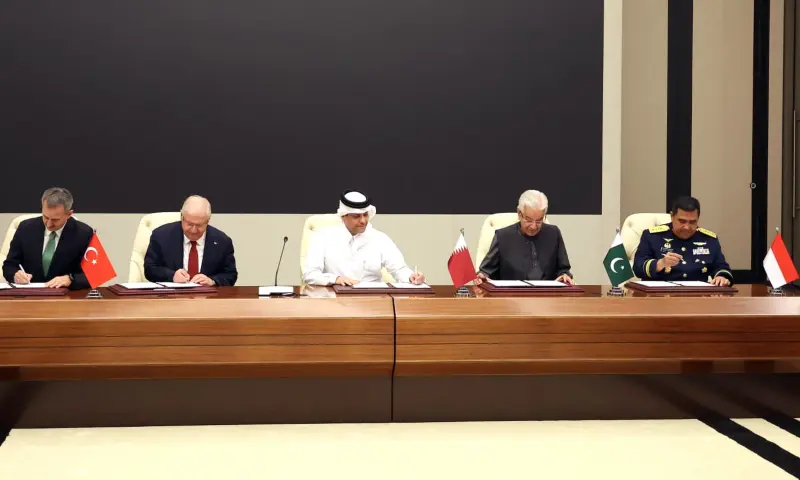
Lahore, October 21: Turkiye, Qatar, Indonesia, and Pakistan have officially signed a comprehensive multilateral defense cooperation agreement designed to strengthen military production, expand technical training, and foster deep industrial partnerships. According to a statement issued by the Turkish National Defense Ministry on Wednesday, the four-way arrangement aims to consolidate separate bilateral defense ties into a unified strategic framework, emphasizing joint manufacturing, research and development, and supply-chain integration.
The newly finalized accord, designated as the Badr memorandum, builds upon extensive bilateral and regional defense arrangements cultivated among the participating nations over recent years. Officials from the participating states noted that the framework seeks to accelerate military modernization through resource sharing, technological collaboration, and enhanced interoperability. The agreement places a primary focus on defense industry development, enabling the signatory governments to leverage individual capabilities across naval, land, and aerospace domains.
The multilateral framework links several established defense relationships, including long-standing naval and land-system cooperation between Pakistan and Turkiye, joint military command structures between Turkiye and Qatar in Doha, and major joint production projects involving Indonesia, such as medium-weight tank development. By institutionalizing these ties under a single multilateral umbrella, Islamabad, Ankara, Doha, and Jakarta intend to streamline joint defense manufacturing and facilitate specialized military training programs.
Expanding Pakistan Turkiye Defense Diplomacy and Regional Security
The formalization of the Badr memorandum coincides with a period of intensive diplomatic and military engagement across South Asia, the Middle East, and Southeast Asia. Earlier this year, high-level defense dialogues underscored Islamabad’s expanding military diplomacy. In January, Indonesian Defense Minister retired Lieutenant General Sjafrie Sjamsoeddin met with Pakistan’s Chief of Defence Forces and Chief of the Army Staff Field Marshal Asim Munir in Rawalpindi, where both sides expressed a shared desire to broaden bilateral defense manufacturing and technical cooperation.
Those discussions followed a high-profile visit last month by Indonesian naval chief Admiral Dr Muhammad Ali, who held separate official talks with President Asif Ali Zardari and Field Marshal Asim Munir. During those meetings, the Inter-Services Public Relations (ISPR) reported that both nations reaffirmed their commitment to deepen professional training, joint military exercises, and naval collaboration.
Simultaneously, Pakistan has maintained active security dialogues with Qatari and Turkish counterparts. Interior Minister Mohsin Naqvi traveled to Doha earlier in the week to confer with his Qatari counterpart on expanding internal security cooperation. These engagements run parallel to broader regional architectures, including the Regional Four (R4) Group comprising Pakistan, Turkiye, Saudi Arabia, and Egypt, as well as the landmark Makkah Defence Alliance finalized earlier in August, which binds Pakistan, Saudi Arabia, and Turkiye under a collective security framework.
The new four-way memorandum with Indonesia and Qatar further extends this diplomatic momentum, providing a structured mechanism for technology transfers and joint equipment procurement outside traditional Western defense supply chains. Analysts note that the pact reflects an ongoing shift toward minilateral security arrangements, allowing middle powers to pool industrial capacity and mitigate supply chain vulnerabilities.
Implementation mechanisms outlined within the agreement involve regular ministerial consultations, specialized technical working groups, and designated oversight committees to monitor collaborative research initiatives. While the text emphasizes industrial collaboration and military readiness rather than offensive postures, participating defense ministries have stressed that the pact will remain open to incremental protocols tailored to specific technological needs. As the signatory governments move toward executing individual subsidiary protocols, defense officials in Islamabad, Ankara, Doha, and Jakarta anticipate that the framework will significantly accelerate joint production schedules and enhance long-term defense self-reliance across all four partner nations.
Read also: Pakistan Assures Full Support to Defend Saudi Arabia Amid Regional Houthi Attacks

Khalid Minhas | Editor, Diplomatic Wire
A veteran journalist with three decades of comprehensive experience, Khalid Minhas has covered politics and international relations in depth throughout his career. He has also contributed to academia, teaching journalism and mass communication as a visiting faculty member at various universities in Pakistan. He holds an M.Phil in Mass Communication and is currently a Ph.D research scholar pursuing advanced studies in the field. He is also the author of the book America, Israel aur Islam, providing insightful analysis on the subject.

Pingback: Pakistan and Maldives Sign 20 Pacts to Deepen Bilateral Ties - DW | Diplomatic Wire