Prime Minister Shehbaz Sharif and visiting Maldives President Dr Mohamed Muizzu witnessed the signing of 20 memorandums of understanding covering defense, trade, and technology. The high-level visit marks the first by a Maldivian leader in eleven years, reinforcing bilateral cooperation.
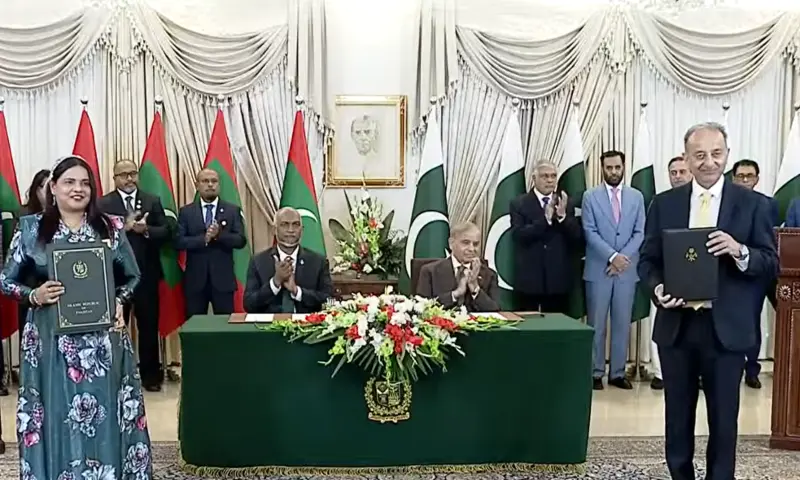
ISLAMABAD, October 21: Prime Minister Shehbaz Sharif vowed on Wednesday to reinforce bilateral cooperation with the Maldives as the two countries signed 20 memorandums of understanding spanning defense, trade, and technology. Maldivian President Dr Mohamed Muizzu arrived in Islamabad on Tuesday for a three-day official visit at the invitation of the prime minister, marking the first visit by a Maldivian head of state to Pakistan in eleven years. The diplomatic engagement coincides with the observance of the 60th anniversary of diplomatic relations between Islamabad and Malé, which were originally established in 1966.
Addressing a joint press stakeout following the formal signing ceremony at the Prime Minister House, Prime Minister Shehbaz stated that both nations would continue to elevate their bilateral ties for all time to come. The premier extended a warm welcome to the visiting president and his accompanying delegation, highlighting historical bonds and mutual goodwill between the two South Asian countries. Prior to the indoor discussions, President Muizzu was received with an official guard of honor performed by contingents representing all three branches of the Pakistan Armed Forces, followed by a ceremonial tree-planting at the Prime Minister House.
The comprehensive framework agreements encompass a wide spectrum of bilateral interests. According to official announcements released after the delegation-level talks, the 20 accords specifically target enhanced defense cooperation, maritime security, information technology, cybersecurity, artificial intelligence, and joint efforts against illicit trafficking and narcotics. Additional protocols address social protection, public health collaboration between food regulatory authorities, the recruitment of health professionals, vocational training promotion, and youth and sports development initiatives. Furthermore, the two governments agreed to expand air connectivity and foster institutional partnerships between respective police academies, civil service training commissions, and public service bodies. Separate agreements were also finalized across agriculture, trade, fisheries, environmental protection, education, tourism, and arts and culture.
Advancing Pakistan Maldives Relations Through Institutional Diplomacy
The high-level discussions in Islamabad build upon a series of recent parliamentary and diplomatic exchanges designed to institutionalize bilateral engagement. Deputy Prime Minister and Foreign Minister Ishaq Dar held a separate meeting with President Muizzu earlier in the day to discuss expanding commercial and diplomatic channels. According to a statement issued by the Foreign Office, Deputy Prime Minister Dar underscored the critical importance of increasing bilateral trade, foreign investment, educational exchanges, climate change mitigation, and tourism promotion.
During their discussions, Deputy Prime Minister Dar welcomed members of the Maldivian business delegation attending the Pakistan-Maldives Business Forum, expressing optimism that business-to-business interactions would yield concrete economic opportunities. The Foreign Office noted that President Muizzu reciprocated the sentiment, affirming his administration’s strong desire to deepen friendly relations with Pakistan and explore mutually beneficial economic partnerships.
The current visit follows earlier legislative interactions, including a diplomatic mission last month by Maldivian parliamentary speaker Abdul Raheem Abdullah, who met with Chief of Defence Forces and Chief of the Army Staff Field Marshal Asim Munir in Rawalpindi to review regional security matters. Diplomatic analysts observe that the systematic conclusion of multiple functional agreements reflects a concerted effort by both capitals to revitalize bilateral mechanisms that had remained dormant over previous years.
Implementation procedures outlined by both administrations involve establishing specialized joint working groups tasked with translating the signed memorandums into operational programs. The relevant ministries in Islamabad and Malé are scheduled to convene review sessions over the coming months to monitor progress across defense production, trade facilitation, and technical assistance agreements.
Read also: Pakistan, Turkiye, Qatar and Indonesia Sign Multilateral Defense Cooperation Pact

The Diplomatic Wire Desk is the institutional news and analysis body of Diplomatic Wire, overseen by Founder and Editor Khalid Minhas. The Desk covers international relations, foreign policy, and critical diplomatic initiatives with objective, timely reporting for a professional readership.