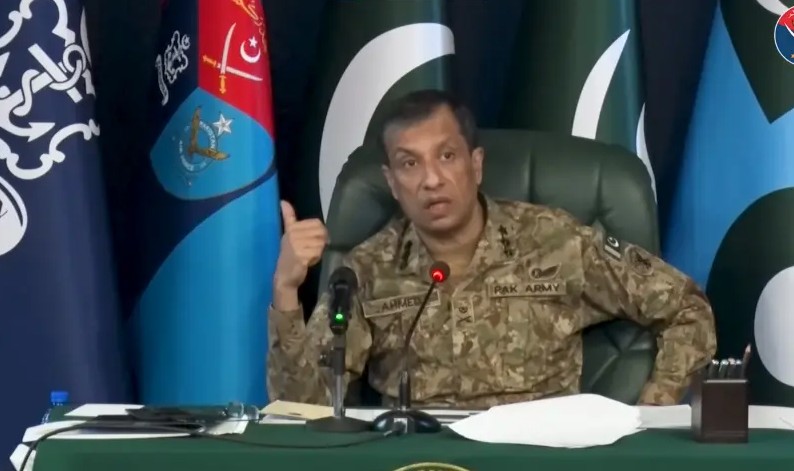
In a significant and strongly worded media briefing, Inter-Services Public Relations (ISPR) Director General Lt Gen Ahmed Sharif Chaudhry unveiled a detailed account of how Afghan forces are actively aiding terrorist infiltration into Pakistan. The revelations shed light on the complex web of cross-border terrorism, governance failures in Afghanistan, and the expanding terror-crime nexus threatening Pakistan’s internal security.
This comprehensive report examines the briefing, offering an authoritative and deeply analytical perspective designed to inform readers and rank competitively on search platforms.
Afghan Forces Engaging Pakistani Posts to Aid Terrorists
Lt Gen Ahmed Sharif revealed that Afghan border posts frequently fire upon Pakistani military positions, not as isolated incidents but as part of a deliberate strategy to divert attention and create movement gaps for terrorists. These coordinated assaults enable militants to slip into Pakistan through rugged, ungoverned terrains.
According to the DG ISPR, only 5–10% of Afghanistan’s border belt has any semblance of governance, leaving vast stretches under the control of non-state actors and tribal authorities. Pakistan faces the brunt of this vacuum, struggling to counter infiltration attempts across a densely tribal, geographically complex frontier.
A Border Defined by Tribes, Not Lines
The briefing highlighted a critical structural challenge: 29 tribes living astride the Pak-Afghan border, with families and clans divided between both countries. These tribes maintain centuries-old movement patterns, making total control nearly impossible.
The DG ISPR asked a pressing question:
“How will you control movement when villages and families are split across the border?”
This reinforces Pakistan’s longstanding argument that the border requires collaborative governance, not unilateral policing.
Why the Fence Alone Cannot Stop Terrorism
Responding to public criticism questioning terrorist infiltration despite fencing, Lt Gen Chaudhry clarified that a fence is not a military obstacle unless backed with observation and firepower.
Border posts are intentionally placed 15–25 km inside Pakistan due to the harsh terrain, heightening the need for technological and manpower-intensive monitoring.
He noted that sealing the 2,600 km Pak-Afghan border hermetically would cost billions and require
- countless posts spaced 2–5 km apart,
- thousands of troops, and
- advanced surveillance drones.
Even the United States, with vastly more resources, couldn’t seal its border with Mexico.
The Expanding Terror–Crime Nexus in Pakistan
A major portion of the briefing focused on the terror-crime network operating within Pakistan’s borders.
Key revelations included:
- Pakistani TTP cells coordinate with Afghan-based leadership.
- Terrorists attack army and FC positions to create diversions for smugglers.
- 400,000–450,000 non-custom-paid vehicles in KP are facilitating terrorist mobility.
- These vehicles are frequently used in VBIED attacks and cross-border movement.
Lt Gen Chaudhry questioned why provincial authorities have failed to crack down on these smuggled vehicles, calling them a core component of the terror-political-criminal nexus.
Breakdown of Pak–Afghan Dialogue: Evidence That Could Not Be Denied
Pakistan presented irrefutable evidence to Afghan authorities and international mediators about TTP operations on Afghan soil.
The Afghan side failed to deny the proof.
Pakistan also expressed willingness for a third-party-verified agreement—a bold offer that underscores Islamabad’s seriousness about resolving cross-border terrorism.
The Post-2021 Crisis: Taliban’s Failure to Become a State Actor
Lt Gen Chaudhry noted that after taking power in 2021, the Afghan Taliban have failed to transition from an insurgent group into a responsible state. Instead, Afghanistan has become a safe haven for multiple international terror groups, including:
- TTP (Fitna Al Khawarij)
- Al Qaeda
- Daesh
- ETIM
- IMU
- Fitna al Hindustan
This sophisticated network threatens not only Pakistan but regional stability.
Pakistan Clarifies: “Our Issue Is with the Afghan Taliban Regime, Not the Afghan People”
The DG reiterated Islamabad’s stance:
- Pakistan has no hostility toward Afghans.
- The issue lies with the Taliban regime’s failure to curb terrorism.
Pakistan has temporarily halted certain trade interactions with Afghanistan, under the principle that “blood and business cannot go together.”
He also categorically denied Afghan allegations of Pakistani strikes inside Afghanistan, calling the accusations baseless.
Mass Repatriation of Illegal Migrants from Pakistan
As part of its national security measures, Pakistan has repatriated 971,604 illegal migrants this year—including 239,574 in November alone.
This marks a dramatic increase from the 366,704 repatriations recorded in 2024.
India’s “Delusional Narrative” and Regional Posturing
Turning to India, Lt Gen Chaudhry criticised the Indian Army Chief’s claims regarding the border conflict earlier this year.
He asserted:
- 7 Indian jets were downed,
- 26 military locations were destroyed,
- S-400 batteries suffered damages.
The DG ISPR accused India of attempting to “sell defeat as victory.”
Foreign-Operated Social Media Accounts Fueling Instability
The briefing exposed multiple foreign-based social media accounts involved in inciting violence, spreading propaganda, and destabilising Balochistan.
With X’s new country-verification feature, many accounts claiming to represent Pakistani activists were revealed to be operating abroad.
KP Governance Gaps Hindering Counter-Terrorism
Lt Gen Chaudhry emphasised that administrative engagement with locals is crucial to defeating terrorism.
However, KP’s local and district governments are failing to implement crucial parts of the National Action Plan, including:
- community outreach,
- district development,
- jirga-based conflict resolution,
- civic administration.
He stressed that military operations alone cannot solve terrorism without governance and local partnership.
Iranian Diesel Smuggling Severely Reduced
Smuggling of Iranian diesel—long a major terror-funding source—has been cut drastically.
- 20.5 million liters/day (past)
- 2.7 million liters/day (after crackdown)
This monumental reduction has disrupted terror financing networks significantly.
Over 67,000 Intelligence-Based Operations in 2025
From January to date:
- 67,023 IBOs conducted nationwide
- 53,000+ in Balochistan
- 12,800+ in KP
- 850 in other provinces
Additionally:
- 4,910 IBOs since Nov 4 (233 per day)
- 206 terrorists killed
Pakistan also faced 4,729 terrorist incidents this year—showing how intense the threat remains.
Conclusion
Pakistan’s security landscape is being reshaped by Afghan governance failures, cross-border militant networks, smuggling economies, and regional geopolitical maneuvering. Lt Gen Ahmed Sharif’s briefing underscores the urgency of comprehensive national security measures, reinforced borders, and diplomatic pressure to ensure regional peace.
Khalid Minhas | Editor, Diplomatic Wire
A veteran journalist with three decades of comprehensive experience, Khalid Minhas has covered politics and international relations in depth throughout his career. He has also contributed to academia, teaching journalism and mass communication as a visiting faculty member at various universities in Pakistan. He holds an M.Phil in Mass Communication and is currently a Ph.D research scholar pursuing advanced studies in the field. He is also the author of the book America, Israel aur Islam, providing insightful analysis on the subject.