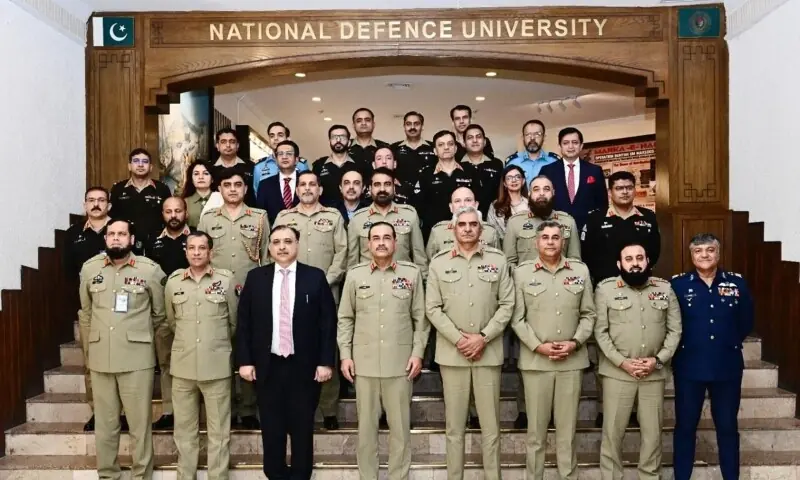
The recent address by Chief of Defence Forces (CDF) and Chief of Army Staff (COAS) Field Marshal Asim Munir at the National Defence University (NDU) marks a significant inflection point in Pakistan’s strategic posturing. While military leaders often speak of “threats,” Munir’s specific focus on “indirect and ambiguous approaches” signals a doctrinal shift in how the Pakistani military perceives the 21st-century battlefield.
This analysis explores the multifaceted nature of what is commonly termed “Gray-Zone Warfare,” the exploitation of internal fault lines, and the necessity of the “multi-domain preparedness” outlined by the Field Marshal.
1. The Death of Distance: Understanding Gray-Zone Warfare
Traditionally, warfare was defined by geography, borders, and clear declarations of intent. However, as Field Marshal Munir noted, hostile actors are increasingly abandoning overt confrontation for a more insidious model. This “ambiguous approach” integrates measures short of war—cyber-attacks, disinformation, and economic coercion—into a cohesive campaign designed to weaken a state from within.
In the South Asian context, this is often described as Hybrid Warfare. By operating below the threshold of open conflict, adversaries can achieve strategic goals without triggering a full-scale military response or international sanctions. The Field Marshal’s warning suggests that the military has identified a persistent trend where the “front line” is no longer a border fence, but the social fabric of the nation itself.
2. The Exploitation of Internal Fault Lines
A critical element of the Field Marshal’s speech was the mention of proxies used to exploit “internal fault lines.” Pakistan, like many diverse post-colonial states, possesses inherent social, ethnic, and sectarian complexities. In a “diffused” security environment, these are no longer just domestic issues; they are strategic vulnerabilities.
- Sub-conventional Conflict: The use of non-state actors in provinces like Balochistan and Khyber Pakhtunkhwa acts as a pressure point. By fueling local grievances through external support, hostile actors force the state to divert resources from national development to internal policing.
- Cognitive Warfare: Perhaps the most “ambiguous” of all domains mentioned was the cognitive domain. This involves the systematic manipulation of public perception. When a population loses trust in its institutions—be they economic, judicial, or military—the state’s “national resilience” erodes.
3. Multi-Domain Preparedness: A Whole-of-Nation Approach
Field Marshal Munir’s call for “comprehensive multi-domain preparedness” acknowledges that the military cannot defend the country in isolation. The domains he listed—intelligence, cyber, information, economic, and military—interlock in ways that require a “synergy amongst all elements of national power.”
| Domain | Nature of Threat | Strategic Requirement |
|---|---|---|
| Cyber | Infrastructure sabotage, data theft | National Cyber Security Frameworks |
| Information | Fake news, deepfakes, propaganda | Fact-checking units & media literacy |
| Economic | Sanctions, grey-listing, trade disruption | Economic stability & indigenous growth |
| Sub-conventional | Proxy insurgencies, terrorism |
This framework moves beyond the “kinetic” (bullets and bombs) and emphasizes the “non-kinetic.” It suggests that a strong economy and a cohesive social narrative are just as vital to national security as a modern tank division.
4. Leadership in the Age of Uncertainty
The Field Marshal’s emphasis on “mental resilience” and “decision-making under uncertainty” is a direct response to the speed of modern conflict. In an era of AI-driven disinformation and rapid-fire cyber-attacks, leaders (both civil and military) no longer have the luxury of time.
At the NDU, Munir underscored that professional military education must evolve. The goal is no longer just to produce commanders who can read a map, but strategic thinkers who can:
- Anticipate: Identify a threat before it manifests as a crisis.
- Recognize: See through the “smoke and mirrors” of a proxy-led narrative.
- Counter: Formulate policies that address the root cause of internal friction rather than just the symptoms.
5. Indigenous Capability and National Resilience
Finally, the Field Marshal linked institutional capacity to long-term national resilience. By advocating for “indigenous capability,” he is pushing for a Pakistan that is less dependent on external fluctuations—be they technological imports or foreign geopolitical shifts.
National resilience is the ability of a society to “bounce back” from a shock. Whether that shock is an economic downturn or a coordinated cyber-attack on the power grid, the Field Marshal’s vision suggests that the ultimate defense is a population that remains “vigilant, adaptive, and steadfast.”
Conclusion: The New Strategic Reality
Field Marshal Asim Munir’s visit to the NDU was more than a routine address; it was a defining statement on the New Strategic Reality. In a world where the lines between peace and war are blurred, Pakistan is pivoting toward a defense model that prizes intellectual agility as much as physical strength.
The message to hostile actors was clear: Pakistan recognizes the “indirect” game being played. The message to the nation’s future leaders was equally sharp: the battlefield has changed, and the mind is now the ultimate high ground.

Khalid Minhas | Editor, Diplomatic Wire
A veteran journalist with three decades of comprehensive experience, Khalid Minhas has covered politics and international relations in depth throughout his career. He has also contributed to academia, teaching journalism and mass communication as a visiting faculty member at various universities in Pakistan. He holds an M.Phil in Mass Communication and is currently a Ph.D research scholar pursuing advanced studies in the field. He is also the author of the book America, Israel aur Islam, providing insightful analysis on the subject.