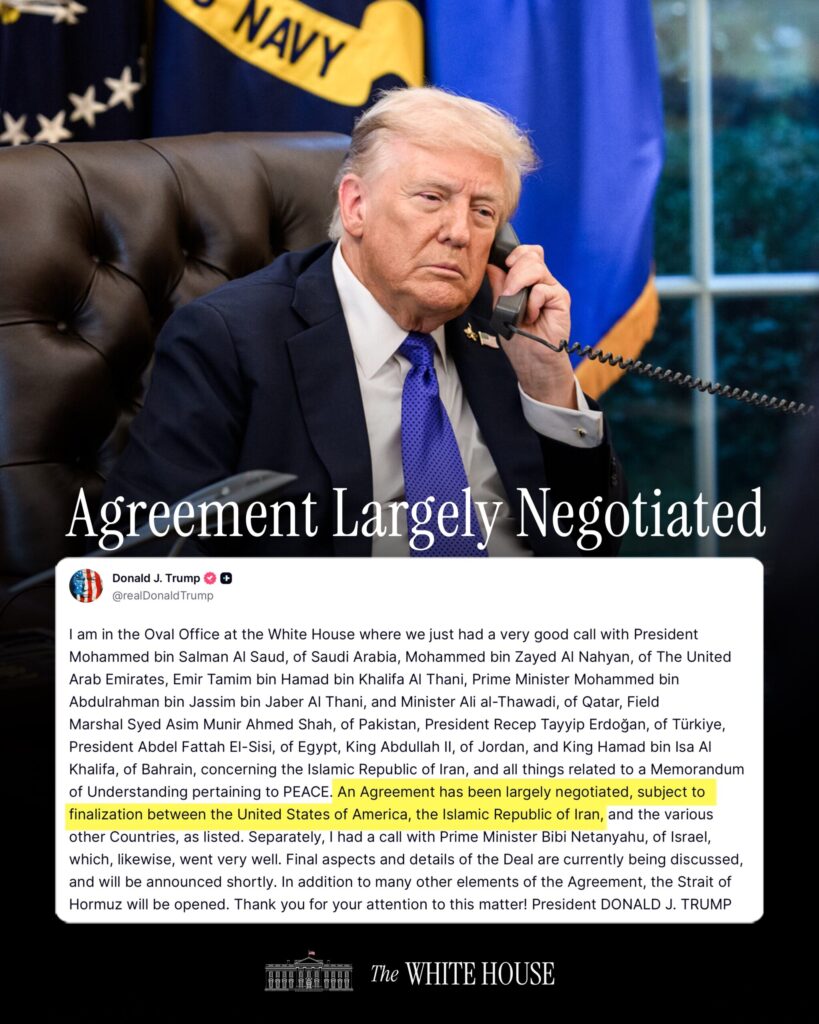
WASHINGTON, D.C. — In a significant diplomatic development, U.S. President Donald Trump announced on Saturday, May 23, 2026, that a comprehensive peace agreement with the Islamic Republic of Iran has been “largely negotiated.” This announcement followed an intense, multi-lateral diplomatic push mediated by regional powers. The proposed framework, structured as a 14-point Memorandum of Understanding (MoU), aims to halt the war initiated in February 2026 by U.S. and Israeli forces against Iran. It also addresses the blockade of Iranian ports and seeks to reopen the strategically vital Strait of Hormuz.
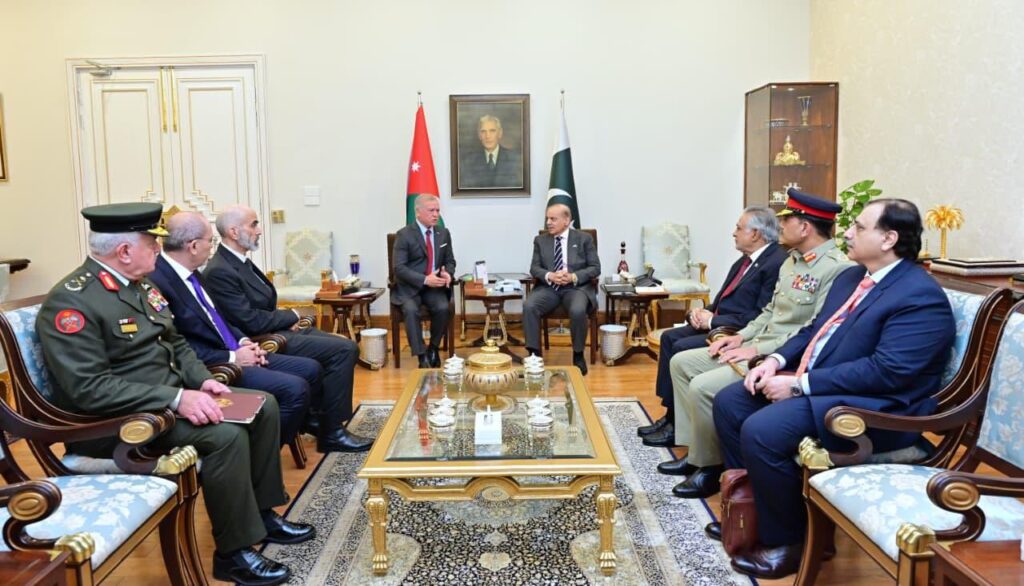
The announcement followed a series of high-level consultations from the Oval Office involving leaders from Saudi Arabia, the United Arab Emirates, Qatar, Pakistan, Turkey, Egypt, Jordan, and Bahrain. President Trump also held a separate discussion with Israeli Prime Minister Benjamin Netanyahu, characterizing the talks as highly productive.
While the White House indicated that final details are undergoing refinement, state media in Tehran and regional briefers have detailed the core elements of the draft text. These include a comprehensive cessation of hostilities on all fronts—including Lebanon—the lifting of the U.S. naval blockade, the unfreezing of billions of dollars in Iranian assets, and a time-bound, 30-to-60-day window to negotiate a lasting resolution to the Iranian nuclear dispute.
Current Development: The 14-Point Draft Framework
The fast-moving diplomatic developments peaked on May 23, 2026, when Pakistani mediators, led by Field Marshal Asim Munir, delivered a revised Iranian proposal to Washington. This text served as the foundation for the multilateral consensus announced by President Trump. According to reports from Al Jazeera, Reuters, and the Associated Press, the finalized framework contains several critical provisions designed to de-escalate the conflict:
- Cessation of Hostilities on All Fronts: The agreement mandates an immediate end to the war, explicitly extending the ceasefire to all operational theaters. This includes Lebanon, where a fragile, U.S.-brokered cessation of hostilities between Israel and Hezbollah has been directly tied to the broader conflict with Iran. Iranian Foreign Ministry spokesperson Esmail Baghaei confirmed that ending the war on all fronts, including Lebanon, remains a core priority for Tehran.
- Reopening of the Strait of Hormuz and Lifting of the Blockade: A central component of the MoU is the immediate restoration of commercial navigation through the Strait of Hormuz. The strategic waterway had been heavily disrupted during the conflict. The draft requires the United States to terminate its naval blockade of Iranian ports—an action Iranian officials characterized as ending maritime interference.
- Release of Frozen Assets and Repatriation: The framework outlines the unfreezing and unlocking of “several billion dollars” in Iranian assets currently held under U.S. sanctions regimes. Tehran has also sought provisions regarding compensation for damages sustained during the air and missile campaigns since February.
- Repositioning of Military Forces: U.S. naval and amphibious combat forces deployed near Iranian territorial waters are slated for repositioning as part of the stabilization protocol.
- The Nuclear Negotiation Timeline: Rather than demanding immediate concessions on enriched uranium as a prerequisite for a ceasefire, the draft establishes a 30-to-60-day window following the declaration of peace to negotiate the final parameters of Iran’s nuclear program. U.S. Secretary of State Marco Rubio reiterated Washington’s position that Iran must not possess a nuclear weapon and must ultimately transfer its highly enriched uranium. However, the current framework defers the mechanics of this resolution to the secondary phase.
The Backgrounder: The Path to the 2026 Conflict
The current conflict began in February 2026, when a series of coordinated military strikes by the United States and Israel targeted command infrastructure, ballistic missile facilities, and nuclear research sites within Iran. This kinetic campaign followed months of escalating tensions over regional proxy dynamics and advancements in Iran’s uranium enrichment capabilities.
[February 2026] US/Israeli Strike Campaign Begins
       │
       ▼
[March–April 2026] Naval Blockade & Strait of Hormuz Closure
       │
       ▼
[Mid-May 2026] Pentagon Inventory Strain (THAAD/SM-3 Depletion)
       │
       ▼
[May 23, 2026] Pakistani-Mediated 14-Point MoU Largely Negotiated
The conflict quickly expanded beyond a localized air campaign. The United States instituted a naval blockade of Iranian ports, seeking to halt energy exports and choke off supply lines to regional state and non-state allies. In response, Tehran restricted traffic through the Strait of Hormuz, a maritime chokepoint responsible for the transit of roughly one-fifth of the world’s liquid petroleum consumption. This closure triggered volatility in global energy markets and disrupted international container shipping.
By May 2026, the intense nature of the missile exchanges began to pressure defensive capabilities. Reports indicated that the United States had expended a significant portion of its advanced missile defense inventory to protect regional assets and allies. This included firing more than 200 Terminal High Altitude Area Defense (THAAD) interceptors and over 100 Standard Missile-3 (SM-3) and Standard Missile-6 (SM-6) variants from naval vessels in the Eastern Mediterranean.
This inventory strain, combined with pressure from regional partners concerned about economic stability, shifted the focus toward a diplomatic solution. Pakistan and Qatar emerged as key intermediaries, shuffling draft texts between Tehran and Washington to establish a sustainable framework.
Stakeholder Analysis
United States
Washington’s primary objectives are ensuring the free flow of commerce through the Strait of Hormuz and securing verifiable limits on Iran’s nuclear capabilities. While President Trump maintained a firm public posture—frequently threatening a resumption of airstrikes if negotiations faltered—the strain on advanced munitions inventories presented a strategic challenge. The administration’s willingness to accept a phased approach suggests a pragmatic pivot toward diplomacy to achieve its non-proliferation goals without risking an extended war of attrition.
Islamic Republic of Iran
Tehran’s primary goals are securing the removal of the naval blockade, reclaiming frozen financial assets, and preserving its sovereign rights under international law. Confronted with economic pressure and domestic infrastructure damage from the bombardment, the Iranian leadership leveraged its control over the Strait of Hormuz to bring Washington to the negotiating table. By linking the maritime reopening to the removal of sanctions and inclusion of the Lebanese front, Iran sought to maintain its regional alliance structure while securing economic relief.
Israel
Israel’s main concerns focus on neutralizing Iran’s ballistic missile capabilities and ending the security threat posed by Hezbollah in Lebanon. While Israel conducted joint operations alongside the United States during the peak of the campaign, its defense systems relied on U.S. logistics and interceptor supplies. Prime Minister Netanyahu’s separate discussions with President Trump indicate that while Israel is aligned with the broader framework, it maintains distinct requirements regarding the verification of Iranian disarmament along its northern border.
Regional Mediators (Pakistan & Qatar)
For Pakistan and Gulf states like Saudi Arabia and the United Arab Emirates, preventing a wider regional war is a core economic and security priority. Pakistan utilized its diplomatic relationships with both Tehran and Washington to draft the 14-point MoU, with Field Marshal Asim Munir conducting direct negotiations in Tehran. Meanwhile, Qatar provided logistical support and diplomatic backing, reflecting the consensus among Gulf Cooperation Council (GCC) states that prolonged instability threatens regional transit routes and economic diversification programs.
Global and Regional Implications
The finalization of the U.S.-Iran Memorandum of Understanding is expected to have immediate effects across global commodity markets and international security architectures.
Energy Security and Maritime Commerce
The formal reopening of the Strait of Hormuz removes a major risk premium from the global oil market. The normalization of shipping lanes is anticipated to lower maritime insurance rates and stabilize energy supply chains, particularly for oil-importing economies in Europe and Asia that depend on Persian Gulf crude.
Regional Alignment and Proxy Dynamics
By binding the ceasefires in Iran and Lebanon together, the agreement establishes a precedent for interconnected security frameworks in the Middle East. However, statements from groups like Hezbollah emphasize that while state-level hostilities may pause, underlying ideological and political alignments remain intact. The durability of the peace will depend on the subsequent 30-to-60-day negotiations regarding regional influence and proxy funding.
Defense Procurement and Non-Proliferation
The conflict has highlighted the rapid consumption rates of advanced air defense systems, which will likely prompt a reassessment of defense production capabilities within the United States and its allies. Furthermore, the upcoming negotiations regarding Iran’s highly enriched uranium will test whether a phased diplomatic model can achieve verifiable non-proliferation outcomes in a deeply polarized environment.
Source Ledger
- The Guardian: Documented President Trump’s Truth Social announcement, details of the 14-point framework, and the diplomatic role of Pakistani mediators.
- Associated Press (AP): Verified the involvement of regional leaders, the 30-to-60-day timeline for nuclear negotiations, and the status of the U.S. naval blockade.
- Reuters: Confirmed the delivery of the revised proposal via Pakistan and provided details on the synchronized ceasefires in Iran and Lebanon.
- Al Jazeera: Supplied detailed parameters of the draft agreement, including asset unfreezing, troop withdrawal frameworks, and the opening of the Strait of Hormuz.
- The Hindu / AFP / Axios: Provided real-time updates on the final hours of the negotiations, the risk of alternative military strikes, and official statements from the Iranian Foreign Ministry.
- The Washington Post / ANI: Provided data regarding the expenditure and inventory status of U.S. missile defense interceptors (THAAD, SM-3, SM-6) during the conflict.

Khalid Minhas | Editor, Diplomatic Wire
A veteran journalist with three decades of comprehensive experience, Khalid Minhas has covered politics and international relations in depth throughout his career. He has also contributed to academia, teaching journalism and mass communication as a visiting faculty member at various universities in Pakistan. He holds an M.Phil in Mass Communication and is currently a Ph.D research scholar pursuing advanced studies in the field. He is also the author of the book America, Israel aur Islam, providing insightful analysis on the subject.