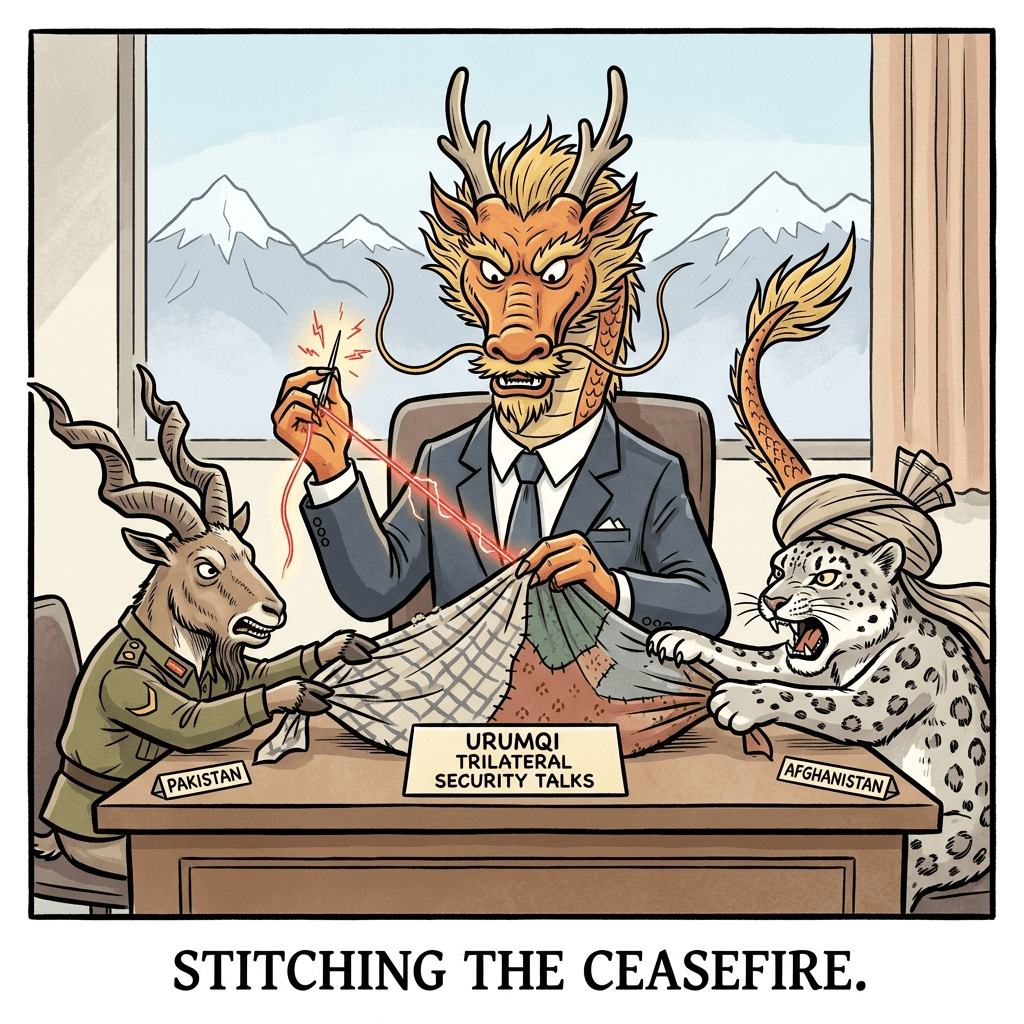
Senior diplomatic and intelligence officials from Pakistan, Afghanistan, and China convened in the Chinese city of Urumqi on Wednesday to address the severe security rift currently destabilizing the region. This high-stakes meeting represents the first formal trilateral engagement since Pakistan initiated Operation Ghazab lil-Haq on February 26, 2026. While the discussions aimed to lower the temperature between Islamabad and Kabul, primary sources within the Pakistani Ministry of Foreign Affairs (MoFA) indicate that a definitive breakthrough remains elusive.
The Nut Graf
The Urumqi summit underscores Beijing’s expanding role as a regional security arbiter in 2026. As the China-Pakistan Economic Corridor (CPEC) enters a more integrated and technologically advanced phase, stability in Afghanistan is no longer a peripheral concern for China but a prerequisite for its transcontinental trade ambitions. For Pakistan, these talks serve as a critical litmus test for the Afghan Taliban’s willingness to implement a verifiable mechanism against the Tehreek-i-Taliban Pakistan (TTP), which has continued to launch cross-border strikes despite repeated diplomatic warnings.
Security Priorities and Operational Deadlocks
The Pakistani delegation, led by the Additional Secretary of the Afghan Desk and supported by high-ranking military and intelligence officials, reiterated a hardline stance during the sessions. According to official reports, Islamabad’s participation was specifically requested by Beijing after Kabul sought Chinese assistance to restore communication. Pakistan has remained firm that the cessation of Operation Ghazab lil-Haq is contingent upon the verifiable dismantling of TTP sanctuaries.
Despite a brief five-day pause in kinetic operations observed during Eidul Fitr—negotiated through the multi-lateral mediation of Saudi Arabia, Qatar, and Turkiye—the Pakistani Foreign Office stated that the mission would continue “until its objectives are achieved.” Field Marshal Asim Munir recently emphasized that peace is only possible if the Taliban regime “renounces their support for terrorist organizations.”
The Afghan delegation, which included members of the Interior Ministry and the General Directorate of Intelligence (GDI), signaled a renewed willingness to “walk the talk.” However, they continued to maintain the public position that TTP actions inside Pakistan do not fall under their direct jurisdictional responsibility. This fundamental disagreement on “responsibility” remains the primary obstacle to a sustainable ceasefire.
The “ETIM” Factor and Chinese Strategic Interests
China’s motivation for hosting these talks extends far beyond traditional diplomacy. Beijing remains acutely concerned about the East Turkestan Islamic Movement (ETIM), a transnational militant outfit known to operate within Afghan borders. For China, the security of its Western frontier and the safety of its personnel working on CPEC projects are paramount.
Sources familiar with the development state that China is pushing for a unified, trilateral counter-terrorism framework. This framework would require the Afghan Taliban to provide transparent evidence of movement restrictions on both TTP and ETIM militants. Consequently, the discussions in Urumqi focused heavily on:
- Establishing a verifiable monitoring mechanism for counter-terrorism demands.
- Reopening vital trade corridors that have been stifled by recent border hostilities.
- Implementing confidence-building measures (CBMs) to prevent unprovoked border skirmishes.
Furthermore, Chinese officials are reportedly leveraging the promise of increased infrastructure investment to incentivize Kabul. However, Islamabad remains skeptical, viewing these “exploratory discussions” as a way to gauge whether the Afghan side is genuinely serious about security cooperation or merely seeking to alleviate economic pressure.
Economic Cooperation Amidst Hostility
Despite the overshadowing security crisis, the trilateral mechanism also touched upon economic integration. Pakistan has signaled a guarded openness toward reopening trade routes, recognizing that a total economic collapse in Afghanistan would likely result in an unmanageable refugee crisis and further regional instability.
The discussions explored the potential for Afghan goods to transit more freely to Chinese markets via Pakistani infrastructure, provided that security guarantees are met. This “security-first” economic model is the cornerstone of Beijing’s 2026 regional policy, attempting to bind the three nations through shared financial interests.
Strategic Outlook
- Conditional De-escalation: Pakistan is unlikely to cease Operation Ghazab lil-Haq permanently without tangible, third-party verified evidence of TTP containment. Furthermore, expect “exploratory” military pauses to be utilized as tactical leverage in future negotiation rounds rather than signs of a permanent truce.
- China’s Arbitrative Ascendance: Beijing is rapidly transitioning from a passive investor to an active security guarantor in Central and South Asia. If the Urumqi mechanism fails to produce results, China may utilize more aggressive economic levers within the Belt and Road Initiative (BRI) to compel Afghan compliance.
- Multi-Aligned Diplomacy: The involvement of Saudi Arabia and Turkiye in previous pauses suggests that the “Kabul-Islamabad” issue is no longer a bilateral affair. Future stability will likely depend on a “congested diplomacy” model where multiple regional powers provide both the carrots and the sticks.
Khalid Minhas | Editor, Diplomatic Wire
A veteran journalist with three decades of comprehensive experience, Khalid Minhas has covered politics and international relations in depth throughout his career. He has also contributed to academia, teaching journalism and mass communication as a visiting faculty member at various universities in Pakistan. He holds an M.Phil in Mass Communication and is currently a Ph.D research scholar pursuing advanced studies in the field. He is also the author of the book America, Israel aur Islam, providing insightful analysis on the subject.