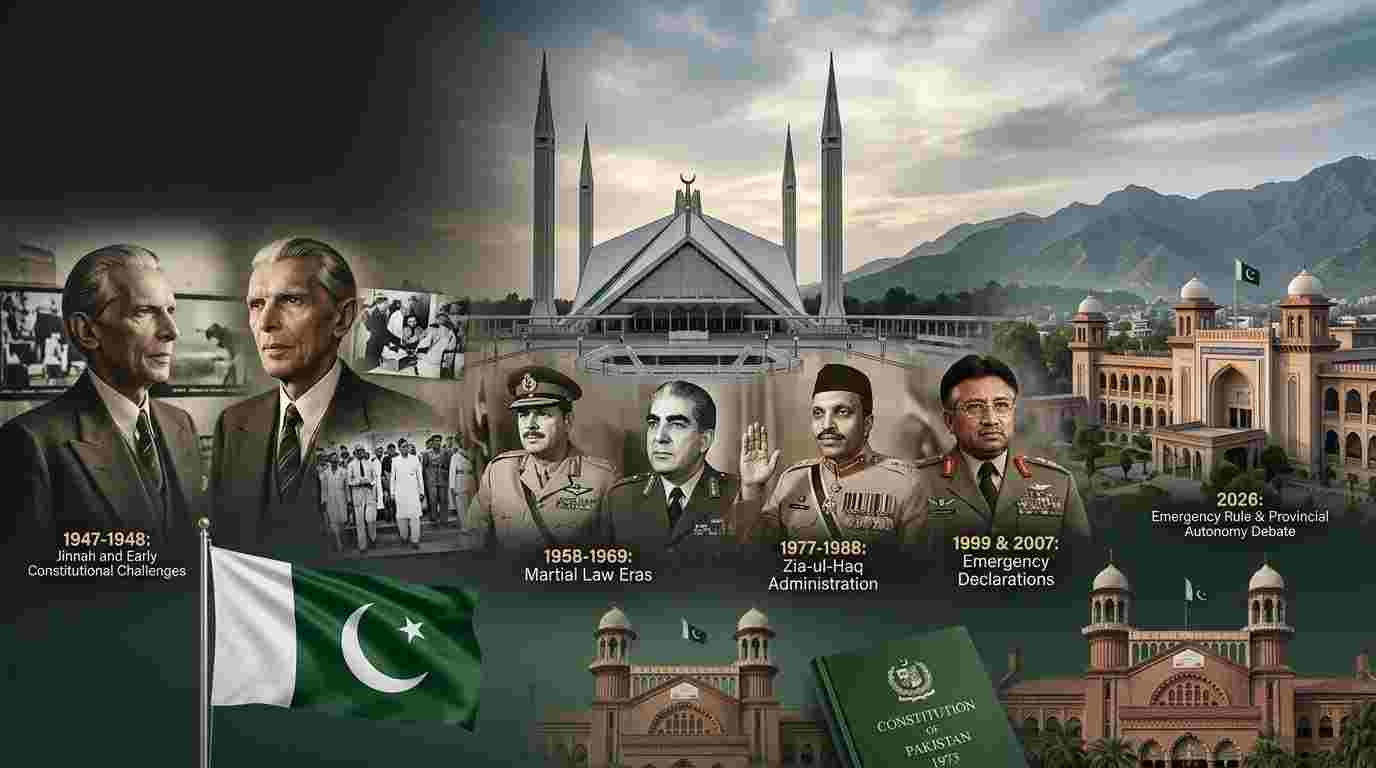
From Pakistan’s first national emergency in 1948 to the 2026 Khyber Pakhtunkhwa crisis, explore the history of emergency rule, martial law and constitutional intervention.
Pakistan’s latest emergency in Khyber Pakhtunkhwa has revived a long-running constitutional debate. From the first national emergency under Quaid-e-Azam to successive martial laws and civilian interventions, the country’s history reveals the changing relationship between federal authority, provincial autonomy and democracy.
Pakistan’s decision to impose an emergency and governor’s rule in Khyber Pakhtunkhwa on October 11, 2026, has brought the country’s history of extraordinary government powers back into focus.
President Asif Ali Zardari approved the federal cabinet’s recommendation under Articles 232 and 234 of the Constitution, according to the President’s House and the government’s official statements. The federal government cited the deteriorating security situation and what it described as inadequate provincial cooperation against terrorism. Pakistan Tehreek-e-Insaf (PTI), which governed the province, opposed the intervention.
The development raises a fundamental question: how has Pakistan used emergency powers since independence, and what distinguishes the current intervention from earlier periods of emergency rule?
The historical record reveals several different forms of intervention. The first national emergency was proclaimed in August 1948, martial law was imposed in Lahore in March 1953, and nationwide martial law followed in October 1958. Later crises involved constitutional emergencies, military takeovers and the transfer of provincial government functions to federal authorities.
Understanding these distinctions is essential to assessing the significance of the latest development.
Pakistan’s First National Emergency: August 1948
Pakistan’s first national emergency was proclaimed on August 27, 1948, during the tenure of Governor-General Muhammad Ali Jinnah.
The proclamation was issued under Section 102 of the Government of India Act, 1935, which continued to provide Pakistan’s constitutional framework after independence.
The immediate justification was the threat to Pakistan’s economic life arising from the mass movement of people across the new international borders following the partition of British India.
Millions of people had migrated between India and Pakistan in 1947. The resulting humanitarian crisis placed enormous pressure on the new state’s finances, administrative institutions and provincial governments.
The emergency expanded the central government’s legislative authority in areas that would ordinarily fall within provincial jurisdiction. It was not martial law and did not establish direct military government.
A historical report reproduced by Dawn in August 2023 records the contemporary announcement and its stated justification.
This episode is significant because it demonstrates that emergency powers were part of Pakistan’s constitutional experience from its earliest years, long before the first nationwide military takeover.
Provincial Government Intervention in the Early Years
Pakistan’s early constitutional history also included the dismissal of provincial governments and the imposition of governor’s rule.
In January 1949, the government of Punjab Chief Minister Nawab Iftikhar Hussain Mamdot was dismissed, and governor’s rule was imposed in the province. Sindh also experienced governor’s rule following the dismissal of Chief Minister Muhammad Ayub Khuhro in December 1951.
These events reflected the growing influence of the central executive over provincial political institutions.
However, governor’s rule should not be confused with a nationwide emergency. The legal basis, geographical scope and consequences of each measure depend on the constitutional arrangements in force at the time.
The distinction is particularly relevant to the current Khyber Pakhtunkhwa situation, where the federal government has invoked constitutional provisions concerning both emergency powers and provincial governance.
Lahore Martial Law: March 1953
Pakistan’s first martial law was imposed in Lahore on March 6, 1953, following violent anti-Ahmadi disturbances and a serious breakdown of public order.
The government placed Lahore under martial law and appointed Lieutenant General Azam Khan as military administrator.
The measure was limited to Lahore rather than being imposed across the entire country. It nevertheless represented an important early instance of the military taking direct responsibility for domestic administration.
The Lahore episode is frequently confused with the nationwide martial law of 1958. The two events were different in their geographical scope and political consequences.
Ghulam Muhammad and the Constitutional Crisis of 1954
On October 24, 1954, Governor-General Ghulam Muhammad dissolved Pakistan’s Constituent Assembly.
The assembly had been responsible for developing the country’s permanent constitutional framework. Its dissolution intensified the conflict between the executive and the legislature.
The resulting legal dispute reached the courts in Federation of Pakistan v. Maulvi Tamizuddin Khan, a landmark case in the country’s constitutional history.
The episode did not constitute Pakistan’s first national emergency. Instead, it marked a major intervention against a representative constitutional institution and became part of a wider struggle over executive authority and parliamentary power.
Nationwide Martial Law in 1958
On October 7, 1958, President Iskander Mirza abrogated the 1956 Constitution, dissolved the national and provincial assemblies, and declared martial law.
General Ayub Khan was appointed Chief Martial Law Administrator.
On October 27, Ayub Khan removed Iskander Mirza from power and assumed the presidency.
The takeover established Pakistan’s first period of nationwide military rule. It displaced the existing constitutional framework and transformed the relationship between the military, the executive and representative institutions.
The distinction between 1948 and 1958 is therefore crucial: the first involved a national emergency under the legal framework inherited at independence, while the second marked a nationwide military takeover and the abrogation of the Constitution.
The 1965 War and the 1971 Crisis
Pakistan also experienced emergency proclamations during its conflicts with India.
On September 6, 1965, President Ayub Khan proclaimed an emergency following the outbreak of war with India. The measure enabled extraordinary state action under the constitutional arrangements then in force.
On November 23, 1971, another emergency was proclaimed as the crisis in East Pakistan intensified, shortly before the full-scale war between India and Pakistan in December.
The 1971 crisis culminated in the separation of East Pakistan and the emergence of Bangladesh.
These developments illustrate the importance of distinguishing wartime emergencies from martial law. Although security crises and military rule have sometimes overlapped in Pakistan, they are not legally interchangeable.
General Yahya Khan and the 1969 Martial Law
On March 25, 1969, Ayub Khan resigned amid widespread political unrest, and General Yahya Khan assumed power under martial law.
Yahya Khan subsequently held Pakistan’s first general elections under universal adult franchise in December 1970. The election results produced a major dispute over the transfer of power between the Awami League, which won a majority in the National Assembly, and political forces in West Pakistan.
The political confrontation escalated into civil war and Indian military intervention. East Pakistan separated in December 1971 and became Bangladesh.
This period remains central to debates about federalism, political representation and the consequences of military intervention in constitutional disputes.
Zia-ul-Haq’s Martial Law in 1977
On July 5, 1977, General Zia-ul-Haq overthrew Prime Minister Zulfikar Ali Bhutto’s government and imposed martial law.
The takeover followed months of political unrest after the disputed March 1977 general election.
Zia initially promised elections, but military rule continued for years. Political activity was restricted, and the military became the dominant institution in the country’s political system.
Bhutto was convicted in a murder-conspiracy case and executed in April 1979, a decision that remains deeply controversial in Pakistan’s political and judicial history.
The 1977 intervention demonstrated how a political crisis could lead to the displacement of civilian government and a prolonged period of military rule.
The 1998 Emergency: Pakistan’s Nuclear Tests
On May 28, 1998, Pakistan conducted nuclear tests in response to India’s nuclear tests earlier that month.
The civilian government of Prime Minister Nawaz Sharif proclaimed a national emergency under Article 232 of the 1973 Constitution. Parliament subsequently approved the proclamation.
Unlike the military takeovers of 1958, 1969 and 1977, the 1998 emergency did not replace the civilian government with direct military rule.
The episode is an important reminder that constitutional emergency powers can be exercised during a national security crisis without necessarily constituting a military coup.
Pervez Musharraf’s Takeover in 1999
On October 12, 1999, General Pervez Musharraf removed Prime Minister Nawaz Sharif’s government and assumed control of the state.
The military takeover displaced normal constitutional government. Musharraf initially governed as Chief Executive and later became president.
Although the event is commonly described as a military coup, it was distinct from the formal emergency proclamation Musharraf issued on November 3, 2007.
The November 2007 Emergency
On November 3, 2007, President and Army Chief Pervez Musharraf proclaimed an emergency and issued a Provisional Constitution Order.
The government cited security concerns and what it described as judicial interference. The measures placed the normal operation of the Constitution in abeyance and led to the removal or exclusion of judges who refused to take a new oath.
Media restrictions were also imposed, and lawyers, political leaders and civil-society activists protested against the measures.
The emergency was withdrawn on December 15, 2007. Pakistan’s Supreme Court subsequently declared Musharraf’s November 3 actions and measures taken under them unconstitutional, illegal and void.
The episode remains an important chapter in the history of judicial independence, executive power and constitutional accountability.
What Does the Constitution Say About Emergency Powers?
Pakistan’s 1973 Constitution contains separate provisions for national emergencies and provincial intervention.
Article 232 provides for a national emergency under specified circumstances, including war, external aggression and certain internal disturbances, subject to constitutional requirements.
Article 233 addresses the operation of specified fundamental rights and their enforcement during an emergency.
Article 234 provides for intervention when a provincial government cannot be carried on in accordance with the Constitution. It allows the President, subject to the article’s conditions, to assume or direct the assumption of specified provincial government functions.
Article 235 deals with a grave threat to Pakistan’s financial stability or credit.
These provisions have different purposes and legal effects. Their use must be assessed against the precise wording of the Constitution, the relevant proclamation and the applicable approval and oversight procedures.
Khyber Pakhtunkhwa Emergency of October 2026
The emergency declared on October 11, 2026, has revived longstanding questions about the balance between federal authority and provincial autonomy.
Read More: President Zardari Approves Emergency in Khyber Pakhtunkhwa
According to Dawn and Radio Pakistan, the federal government cited worsening terrorism and what it described as a lack of adequate provincial cooperation in counterterrorism efforts. The President’s House confirmed the use of Articles 232 and 234.
Law Minister Azam Nazeer Tarar stated that the provincial government’s functions had been transferred to the governor and that an 11-member advisory council would assist in running provincial affairs. The government also announced administrative arrangements affecting 12 districts.
PTI opposed the intervention. Its leaders argued that weakening provincial autonomy would not resolve the security crisis and challenged the legitimacy of the federal government’s action.
These are competing political positions. The government’s stated security rationale and the opposition’s objections must be distinguished from the separate legal question of whether the constitutional requirements for intervention have been satisfied.
The proclamation, the supporting reports, the applicable parliamentary procedures and any judicial challenges will be important in determining the measure’s legal status and longer-term consequences.
How Does the 2026 Emergency Differ from Earlier Interventions?
The latest development differs from Pakistan’s earlier episodes of emergency rule in several respects.
The 1948 emergency expanded central legislative authority in response to the economic and administrative pressures created by partition. The 1953 Lahore martial law was a geographically limited security measure. The 1958 martial law displaced the constitutional system nationwide.
The 1998 emergency occurred under a civilian government during a period of international tension. The 2007 emergency involved a confrontation between the executive and judiciary and the suspension of the Constitution’s normal operation.
The 2026 intervention, by contrast, combines a national emergency proclamation with governor’s rule in a province governed by an opposition party. It therefore raises questions about security, constitutional procedure, federalism and the continuation of representative provincial government.
The legal implications cannot be determined solely by comparing the political circumstances of these events. Each intervention must be examined under the law applicable at the time.
What Pakistan’s History of Emergency Rule Reveals
Pakistan’s experience since 1947 shows that emergency powers have been invoked for different reasons, including mass migration, war, public disorder, political confrontation and security concerns.
The country’s history also demonstrates that emergency proclamations, provincial governor’s rule and military takeovers are distinct forms of intervention. Their consequences depend on the legal authority invoked, the institutions affected and the extent to which constitutional safeguards remain operational.
The October 2026 emergency in Khyber Pakhtunkhwa is the latest major development in this history. Its significance will depend on the implementation of the proclamation, the response of Parliament and the courts, and the restoration or continuation of normal provincial governance.
Ultimately, Pakistan’s constitutional challenge is to address genuine security threats while preserving the rule of law, democratic accountability and the constitutional division of powers between the federation and the provinces.
Sources:
Dawn — 1948: Seventy-five years ago: Emergency proclamation — contemporary reporting reproduced in a historical archive.
Dawn — Timeline: A concise history of emergency rule in Pakistan — provincial governor’s rule and historical context.
National Assembly of Pakistan — Parliamentary and constitutional history — the 1958 martial law and constitutional chronology.
Supreme Court of Pakistan — Constitutional judgment discussing the 1965 and 1971 emergencies.
Library of Congress — Pakistan: Constitutionality of the Proclamation of Emergency — the 2007 emergency.
Constitution of Pakistan — Article 232 — the constitutional basis for national emergencies.

Khalid Minhas | Editor, Diplomatic Wire
A veteran journalist with three decades of comprehensive experience, Khalid Minhas has covered politics and international relations in depth throughout his career. He has also contributed to academia, teaching journalism and mass communication as a visiting faculty member at various universities in Pakistan. He holds an M.Phil in Mass Communication and is currently a Ph.D research scholar pursuing advanced studies in the field. He is also the author of the book America, Israel aur Islam, providing insightful analysis on the subject.