Pakistan will send its first astronaut into orbit from a Chinese space centre on November 25, according to Planning Minister Ahsan Iqbal. Speaking in Narowal, the minister also outlined a long-term vision for a lunar landing by 2035, cementing bilateral space cooperation with Beijing.
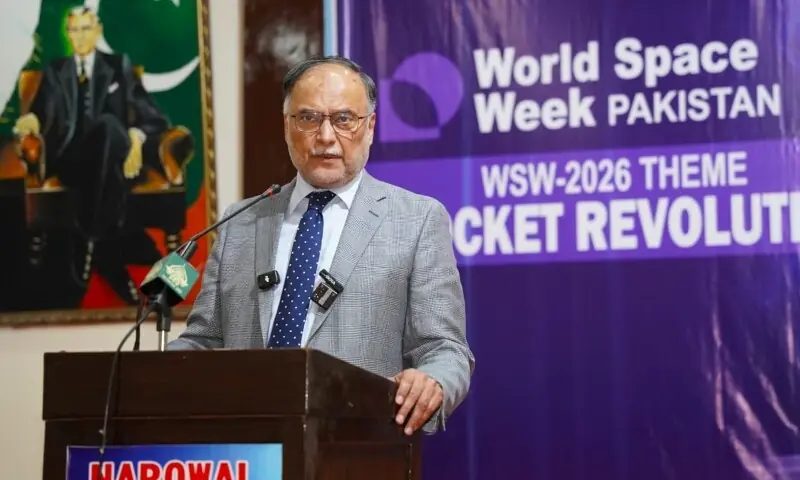
NAROWAL, October 18: Pakistan’s first astronaut will undertake a historic space mission from a Chinese space centre on November 25, Federal Minister for Planning, Development, and Special Initiatives Ahsan Iqbal announced on Sunday.
The formal announcement was made while the planning minister was addressing the concluding ceremony of World Space Week in Narowal, which was organized in collaboration with the Pakistan Space and Upper Atmosphere Research Commission (Suparco), according to an official ministry statement. The upcoming flight marks a monumental milestone for the nation’s space programme, positioning Pakistan to enter the era of human spaceflight through a strategic partnership with China.
Elaborating on the country’s long-term space ambitions during his address, the planning minister revealed that Pakistan is actively aiming to achieve an independent lunar landing by 2035. Iqbal expressed strong optimism that deepening bilateral space cooperation with China will help Pakistan reach new heights in space exploration, scientific research, and advanced technological development.
Highlighting the broader socio-economic applications of orbital technology, Iqbal emphasized that modern space technology remains indispensable for domestic agriculture, telecommunications, climate change monitoring, education systems, and national security. He stressed that continuous investment in scientific research and space exploration is essential for national technological advancement and global competitiveness.
Furthermore, the planning minister announced that the government intends to establish Pakistan’s first-ever Space Museum at the University of Narowal. The proposed museum aims to promote scientific awareness, encourage educational curiosity, and inspire younger generations to pursue careers in space science and modern engineering disciplines. Drawing on historical context, Iqbal noted that early Muslim scholars made pioneering contributions to astronomy and global scientific discovery, calling for renewed domestic efforts to restore Pakistan’s historical leadership in knowledge creation and research.
Pakistan Space Mission and Selection Process
The designated space traveller will be selected from a pool of two elite pilot candidates—Zeeshan Ali and Khurram Daud—who were shortlisted by China in April for its rigorous manned space programme. Both candidates have been undergoing intensive astronaut training modules in Beijing alongside Chinese instructors.
While Beijing has not yet officially named which of the two pilots will occupy the final seat or manage specific flight sequences, aerospace officials indicate that a final selection is imminent. According to Suparco officials overseeing human spaceflight cooperation, the chosen pilot will serve in orbit with the functional title of “payload specialist,” carrying responsibility for executing Pakistan’s dedicated scientific experiments in microgravity rather than piloting the launch vehicle itself.
The selected specialist will fly aboard a Chinese-built spacecraft launched from an official Chinese facility, operating under the instruction of trained mission controllers and utilizing Mandarin for orbital communications. This cooperative framework underscores the expanding technological and diplomatic alliance between Islamabad and Beijing in high-tech sectors.
Read also: Ahsan Iqbal Invites Chinese Investors to Establish Manufacturing Bases Under CPEC 2.0

The Diplomatic Wire Desk is the institutional news and analysis body of Diplomatic Wire, overseen by Founder and Editor Khalid Minhas. The Desk covers international relations, foreign policy, and critical diplomatic initiatives with objective, timely reporting for a professional readership.