
The mother of all bombs is a massive conventional weapon in the United States military arsenal. Formally designated as the GBU-43/B Massive Ordnance Air Blast, it is designed to destroy deeply buried infrastructure and cave networks without using nuclear capabilities.
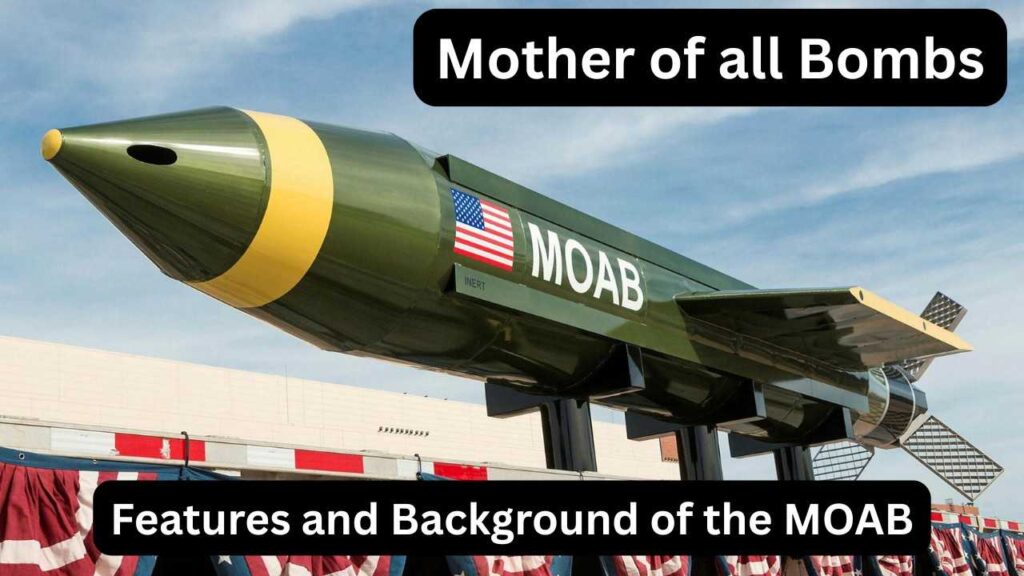
The term “mother of all bombs” refers to the GBU-43/B Massive Ordnance Air Blast (MOAB), a high-yield conventional thermobaric bomb developed by the United States military. As discussions surrounding high-payload conventional ordnance and regional security strategies re-enter public discourse, defense analysts and military officials frequently reference this weapon to distinguish conventional high-impact munitions from atomic capabilities.
Developed by the United States Air Force Research Laboratory during the early 2000s, the MOAB is among the largest non-nuclear weapons ever deployed in combat. Weighing approximately 21,600 pounds, the weapon is guided by a global positioning system (GPS) and is typically deployed from the rear cargo ramp of a specialized cargo aircraft, such as the MC-130 Combat Talon, rather than a traditional fighter-bomber or strategic bomber.
According to military specifications and defense reports, the weapon utilizes a composite high explosive that creates a massive blast wave characterized by extreme overpressure and high temperature. The primary tactical purpose of the MOAB is to destroy heavily fortified underground bunkers, tunnel systems, cavernous storage facilities, and complex mountainous terrain that resist standard penetration bombs. When detonated above the ground or just prior to impact, the thermobaric payload consumes surrounding oxygen to generate an intense, prolonged blast wave capable of collapsing subterranean structures over a wide area.
Operational History and Strategic Context of the Mother of All Bombs
While the GBU-43/B has been a prominent part of the United States conventional inventory for over two decades, its actual combat usage has been rare. Defense officials recorded its first operational deployment in April 2017, when the United States military dropped a single MOAB targeting a complex network of tunnels and caves utilized by militant groups in the Achin district of Nangarhar province, Afghanistan.
Read also : Trump Rules Out Nuclear Weapons against Iran
Military planners emphasize that despite its immense destructive capacity and widespread colloquial moniker, the MOAB remains strictly a conventional weapon. Unlike tactical or strategic nuclear warheads, it does not produce radioactive fallout, nuclear fission, or long-term radiological contamination. Defense analysts note that political and military leadership frequently evaluate such conventional heavy ordnance as an alternative option when addressing hardened underground installations, thereby avoiding the geopolitical and humanitarian thresholds associated with nuclear escalation.
Recent diplomatic and strategic discussions have highlighted the weapon as governments and defense observers evaluate potential contingencies involving fortified nuclear or military infrastructure in various geopolitical flashpoints. While statements from senior American leadership have explicitly ruled out the use of nuclear weapons in specific regional theaters, discussions regarding heavy conventional munitions underscore the ongoing debate over the utility and deterrent value of large-payload ordnance in modern conflict scenarios.
The United States military continues to maintain and evaluate various heavy conventional strike options within its broader strategic inventory. These capabilities allow command structures to project force against deeply buried targets while keeping operations strictly within conventional military boundaries. Defense observers and international arms control experts monitor these developments closely, analyzing how conventional deterrence and high-yield ordnance impact global security stability and strategic doctrines across different regions.
United States President Donald Trump has formally ruled out the deployment of nuclear weapons against Iran, asserting during a media broadcast that Washington does not require atomic capabilities to achieve its strategic objectives in the region.
Speaking during an interview with Newsmax, President Trump addressed recent media reports suggesting that his administration was evaluating options to utilize heavy conventional munitions against Iranian infrastructure, potentially following upcoming US midterm elections. Clarifying the nature of the heavy conventional ordnance often referenced in security discussions, Trump stressed that the weapon is entirely non-nuclear.
”Well, the mother of all bombs is not nuclear. It’s not nuclear at all,” Trump told Newsmax during the interview. “This is just an extremely large bomb. It’s like a tiny nuclear bomb, but the mother of all bombs is one big bomb. But it’s not nuclear. No, I wouldn’t use nuclear. We don’t have to.”
The US president reiterated that American military planning did not necessitate crossing the nuclear threshold to manage regional security challenges. His remarks followed recent reporting by media outlets, citing defense and administration officials, which indicated that the US military had prepared updated strike options involving heavy conventional munitions targeting various energy and military installations.
Trump Discusses Potential Options and Clarifies Non-Nuclear Status of the Mother of All Bombs
Expanding on potential future military actions, President Trump raised the prospect of conducting operations against specific targets inside Iran, drawing particular attention to a suspected underground facility often referenced in strategic planning.
When asked by interviewers whether any such future operations would entail the deployment of American ground troops inside Iranian territory, the president firmly dismissed the possibility. “No, I don’t see that. I don’t see that,” Trump replied, maintaining that ground deployments remain off the table.
The discussions surrounding potential military maneuvers occur against a backdrop of fluctuating tensions between Washington and Tehran. Over recent months, military forces have engaged in intermittent assessments regarding conventional assets, air defense installations, and missile storage facilities, particularly around key maritime transit routes. Meanwhile, international diplomatic efforts and regional security arrangements continue to navigate the complex diplomatic landscape surrounding Iran’s nuclear program.
President Trump also touched upon broader global nuclear security dynamics during the broadcast, pointing to the size and status of the American nuclear arsenal relative to other global powers. He noted that Washington maintains a robust deterrent posture while expressing a theoretical openness to future international arms control discussions regarding strategic stability.
Defense analysts and international arms control experts monitor these developments closely, analyzing how conventional deterrence and high-yield ordnance impact global security stability and strategic doctrines across different regions. Military planners emphasize that despite its immense destructive capacity and widespread colloquial moniker, the weapon remains strictly a conventional device without radioactive fallout.

The Diplomatic Wire Desk is the institutional news and analysis body of Diplomatic Wire, overseen by Founder and Editor Khalid Minhas. The Desk covers international relations, foreign policy, and critical diplomatic initiatives with objective, timely reporting for a professional readership.