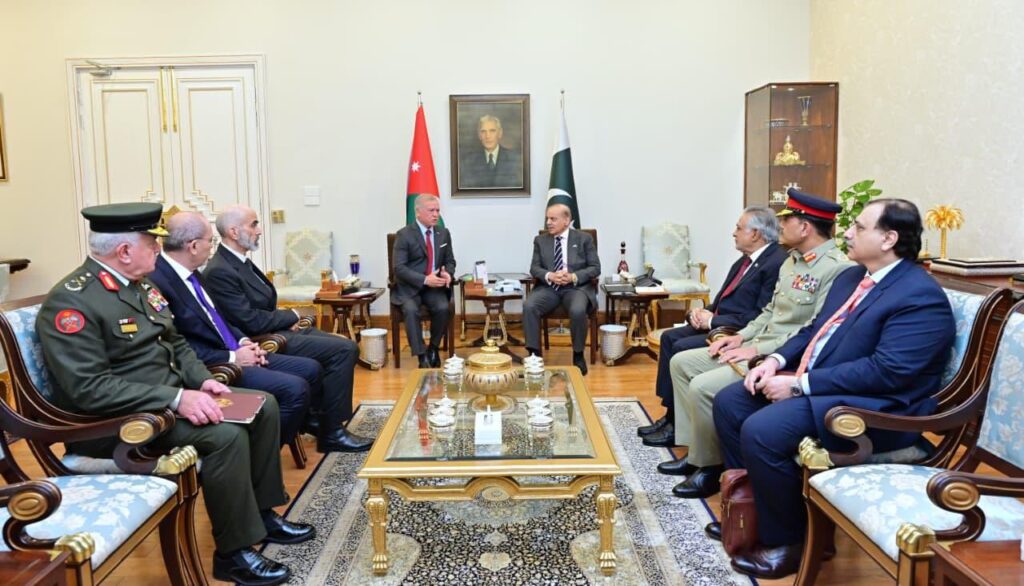
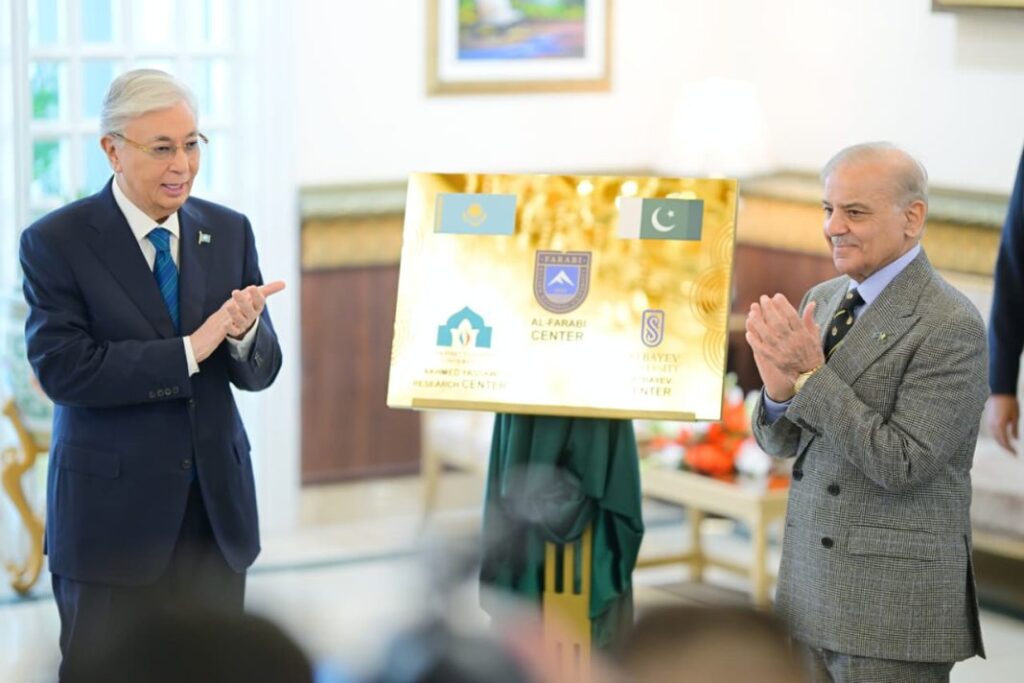
ISLAMABAD — Prime Minister Muhammad Shehbaz Sharif and Kazakh President Kassym-Jomart Tokayev signed a landmark Joint Declaration today, formally establishing a Strategic Partnership between Pakistan and Kazakhstan. The signing occurred during President Tokayev’s historic two-day state visit to the capital, the first by a Kazakh head of state in 23 years.
In a comprehensive diplomatic engagement at the Prime Minister House, the two nations finalized 37 Memoranda of Understanding (MoUs) and agreements. These accords span critical sectors including petroleum, mining, digital development, and maritime affairs. A central pillar of the talks was the commitment to increase bilateral trade from the current $250 million to $1 billion within the next year.
Geopolitical Significance: The “Southern Pivot”
This visit codifies Kazakhstan’s “Southern Pivot” strategy, transitioning the landlocked Central Asian power into a “land-linked” entity via Pakistan’s Arabian Sea ports. By integrating Kazakhstan’s resource wealth with Pakistan’s maritime infrastructure, both nations are positioning themselves as central architects of a new Eurasian trade architecture that bypasses traditional geopolitical bottlenecks.
Strategic Cooperation and Regional Connectivity
During delegation-level talks, Prime Minister Sharif emphasized that the high-level exchange marks a “historic milestone.” The inclusion of Field Marshal Syed Asim Munir, Chief of Army Staff (COAS), in the one-on-one meetings underscores the deep security and defense dimensions of the new partnership.
Key Industrial and Economic Agreements:
- Transit Trade: Formalization of the Pakistan-Kazakhstan Transit Trade Agreement (TTA) to facilitate seamless cargo movement.
- Energy and Mining: Joint ventures in petroleum and mineral exploration, leveraging Kazakhstan’s vast natural reserves.
- Digital Governance: Collaboration on Artificial Intelligence (AI) and digital infrastructure, spearheaded by the respective IT ministries.
- Regional Corridors: Agreement to advance the Belarus-Russia-Kazakhstan-Uzbekistan-Afghanistan-Pakistan transport corridor.
Furthermore, President Tokayev highlighted the importance of the TAPI (Turkmenistan-Afghanistan-Pakistan-India) gas pipeline and the potential for resuming direct air links to bolster tourism and people-to-people exchanges.
“Pakistan recognizes Kazakhstan as a strategic and most valued partner in Central Asia,” stated Prime Minister Sharif. “We have offered Kazakhstan full access to our transit infrastructure and seaport facilities at Gwadar and Karachi.”
Strategic Outlook
- Trade Integration: The establishment of a five-year economic roadmap and a dedicated Working Committee suggests that the $1 billion trade target is a baseline for a much deeper, long-term integration of Central and South Asian markets.
- Maritime Shift: Kazakhstan’s formal commitment to using Gwadar and Karachi ports will likely accelerate infrastructure projects under the “land-linked” framework, potentially challenging the dominance of northern trade routes.
- Security Convergence: The presence of top military leadership indicates a synchronized approach toward regional stability, particularly concerning counter-terrorism and Afghanistan’s role as a transit bridge.

Khalid Minhas | Editor, Diplomatic Wire
A veteran journalist with three decades of comprehensive experience, Khalid Minhas has covered politics and international relations in depth throughout his career. He has also contributed to academia, teaching journalism and mass communication as a visiting faculty member at various universities in Pakistan. He holds an M.Phil in Mass Communication and is currently a Ph.D research scholar pursuing advanced studies in the field. He is also the author of the book America, Israel aur Islam, providing insightful analysis on the subject.