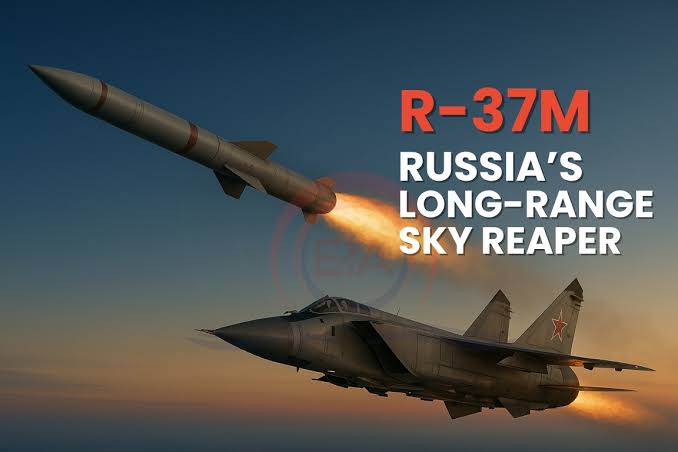
Russia has officially approved the export of the R-37M hypersonic air-to-air missile to India in a landmark $1.2 billion deal.The agreement includes the delivery of approximately 300 missiles, which will be integrated into the Indian Air Force’s Su-30MKI fighter fleet. This strategic move comes after an Indian defense review identified a critical “range gap” in its current arsenal—specifically, a vulnerability against the Pakistan Air Force and its Chinese-supplied munitions. The R-37M is an ultra-long-range hypersonic missile, and its induction is expected to significantly shift the aerial warfare balance in South Asia.
NEW DELHI / MOSCOW — The Russian Federation has formally authorized the export of the R-37M ultra-long-range air-to-air missile to India, marking a pivotal escalation in South Asian aerial warfare capabilities. The deal, valued at US$1.2 billion, encompasses the delivery of approximately 300 missiles. These will be integrated into the Indian Air Force (IAF) Su-30MKI fleet. This move follows a strategic review in New Delhi that highlighted a critical “range gap” against the Pakistan Air Force (PAF) and its Chinese-supplied munitions.
The Geopolitical Significance
The R-37M, with a confirmed engagement range of up to 350–400 km, effectively ends the brief era of Pakistani BVR (Beyond-Visual-Range) dominance established by the PL-15. By acquiring a hypersonic “AWACS-killer,” India is not merely matching Pakistan’s reach; it is fundamentally threatening the airborne command-and-control infrastructure that sustains PAF operations. Consequently, this deal reaffirms Moscow’s role as India’s “lender of last resort” for high-end strategic technology during periods of regional tension.
Technical Superiority and Tactical Necessity
The decision to prioritize the R-37M over domestic alternatives like the Astra Mk3 stems from the urgent requirements of the Su-30MKI upgrade program. According to reports from Defence Security Asia and Military Watch Magazine, the IAF fast-tracked the acquisition following the 2025 “Operation Sindoor” incident. During that engagement, PAF J-10CE fighters utilizing PL-15 missiles reportedly forced Indian interceptors to remain on the defensive due to a superior engagement envelope.
Key Performance Metrics
Parameter R-37M (RVV-BD) PL-15 (Pakistan/China) Max Speed Mach 6.0 (Hypersonic) Mach 4.0+ Max Range 350–400 km 200–250 km Primary Target AEW&C, Tankers, Heavy Fighters Tactical Fighters Guidance Active Radar + Inertial Active Radar (AESA)
Impact on Pakistan’s Strategic Depth
For the Pakistan Air Force, the introduction of the R-37M presents a significant challenge to its Saab Erieye and ZDK-03 AWACS platforms. These “force multipliers” are essential for Pakistan’s integrated air defense.
- Denial of High-Value Assets: The R-37M allows the IAF to target Pakistani command planes from within Indian airspace. This forces PAF surveillance assets to operate further back, reducing their radar coverage over the Line of Control (LoC).
- Neutralization of PL-15 Advantage: The PL-15 previously allowed Pakistani pilots to “fire and forget” from distances Indian missiles could not reach. The R-37M restores “first-shot” parity to the Su-30MKI.
- CPEC Security: As China increases its footprint in Pakistani airbases to secure CPEC corridors, the presence of 400km-range Indian missiles complicates the safety of Chinese ISR (Intelligence, Surveillance, and Reconnaissance) missions.
Official Verification and Current Status
Official sources within the Indian Ministry of Defence indicate that the deal is being processed under the “Emergency Procurement” window. Furthermore, Rosoboronexport—Russia’s state intermediary for defense exports—has listed the RVV-BD (the export variant of the R-37M) as “cleared for strategic partners” in its 2026 catalog. While a formal press communiqué from the Prime Minister’s Office (PMO) is awaited, the integration of software patches for the Su-30MKI’s Bars radar has already commenced at HAL facilities.
Strategic Outlook
- Pakistani Counter-Response: The PAF is expected to lobby Beijing for the PL-17 (with a rumored 400km range) or the PL-21 to regain its standoff advantage. This will likely accelerate the transition to 5th-generation platforms like the FC-31.
- Indo-Russian Synergy: Despite Western sanctions on Moscow, this deal proves that the Indian defense establishment views Russian missile technology as indispensable for countering Chinese-made hardware in the region.
- Escalation Risks: The ability to strike deep into sovereign airspace from long distances decreases the “buffer zone” between air forces. Consequently, the risk of accidental escalation during routine patrols will likely increase throughout 2026.
Click here for Latest News

Khalid Minhas | Editor, Diplomatic Wire
A veteran journalist with three decades of comprehensive experience, Khalid Minhas has covered politics and international relations in depth throughout his career. He has also contributed to academia, teaching journalism and mass communication as a visiting faculty member at various universities in Pakistan. He holds an M.Phil in Mass Communication and is currently a Ph.D research scholar pursuing advanced studies in the field. He is also the author of the book America, Israel aur Islam, providing insightful analysis on the subject.