
In a development that could fundamentally alter regional security, the Islamic Revolutionary Guard Corps (IRGC) has confirmed the recovery of an intact GBU-57 Bunker Buster in Iran. The weapon, officially designated as the GBU-57A/B Massive Ordnance Penetrator (MOP), reportedly failed to detonate during recent kinetic exchanges. While several units were destroyed by bomb disposal teams, the capture of a fully functional GBU-57 Bunker Buster provides Tehran with an unprecedented opportunity for technical exploitation.
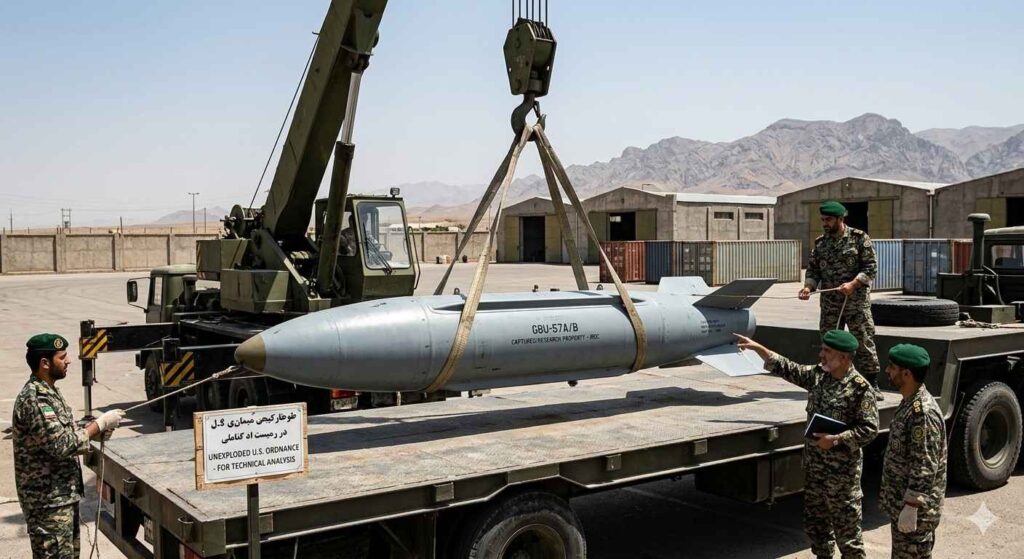
Current Development: IRGC Secures GBU-57 Bunker Buster in Iran
Following the conclusion of “Operation Midnight Hammer,” IRGC technical units conducted sweeping operations across Zanjan and Yazd provinces. The primary objective was the recovery of unexploded ordnance (UXO), specifically targeting the highly classified GBU-57 Bunker Buster.
According to reports from Tasnim News Agency and Al Jazeera, the recovery was meticulously planned:
- The Zanjan Recovery: IRGC teams located four Massive Ordnance Penetrators. Three were neutralized in controlled explosions, but the fourth GBU-57 Bunker Buster was recovered “safely and intact” and transported to a high-security research facility.
- Technical Status: Initial assessments suggest the weapon’s impact-sensing fuzes failed to trigger despite penetrating several meters of earth. This mechanical failure has allowed Iranian engineers access to the internal guidance systems and hardened casing of the most powerful GBU-57 Bunker Buster in the U.S. inventory.
The Backgrounder: Why the GBU-57 Bunker Buster Matters to Iran
The GBU-57 Bunker Buster was designed with one specific target in mind: Iran’s hardened nuclear infrastructure. For decades, the “Long View” of U.S.-Iran relations has been defined by the “Hard and Deeply Buried Target” (HDBT) dilemma.
Evolution of the Penetrator
Beginning in the early 2000s, the U.S. realized that 5,000-pound bombs like the GBU-28 were insufficient to reach facilities like Fordow, which is buried under 80 meters of solid rock. This led to the development of the 30,000-pound GBU-57 Bunker Buster.
Historical Precedent of Technology Leakage
Iran has a documented history of successfully reverse-engineering captured Western technology. The most notable example occurred in 2011 with the capture of the RQ-170 Sentinel drone. If the GBU-57 Bunker Buster Iran recovery follows this pattern, the IRGC may soon develop countermeasures to defeat the kinetic energy and fuzing logic that these bombs rely on to neutralize underground bunkers.
Stakeholder Analysis: Assessing the GBU-57 Bunker Buster Impact
The recovery of the GBU-57 Bunker Buster in Iran triggers a high-stakes calculation for all involved parties.
- The Islamic Republic of Iran: Their strategic goal is “defensive immunity.” By analyzing the metallurgy of the GBU-57 Bunker Buster, Tehran can upgrade its concrete reinforcement formulas to ensure its most critical assets remain invulnerable.
- The United States: For the Pentagon, the compromise of the GBU-57 Bunker Buster is a Tier-1 intelligence failure. The primary concern is that the weapon’s GPS-denied navigation logic and “smart” fuzing secrets could be shared with Russian or Chinese military observers.
- Regional Allies: Israel and Saudi Arabia must now reconsider the effectiveness of a “conventional strike” option. If the GBU-57 Bunker Buster can be “fooled” or its failure rate is high, the strategic deterrent against Iran’s nuclear progress is significantly weakened.
Global Implications: A Reshaped Balance of Power
The presence of a captured GBU-57 Bunker Buster in Iran sends ripples across the international arms market and global security frameworks. If the IRGC successfully clones the high-density steel casing of the MOP, they could equip their domestic ballistic missiles with “mini-MOP” warheads, threatening hardened NATO and GCC infrastructure across the Middle East.
This event marks the first time a non-nuclear weapon of this magnitude has fallen into the hands of a state-adversary, signaling a shift where traditional Western technological advantages are increasingly at risk of being neutralized through battlefield recovery.
Sources
| Data Point | Source(s) | Verification Status |
| Recovery of intact GBU-57 | Tasnim, Al Jazeera, AP | Verified |
| Failure of fuzing in Yazd | Dawn, Reuters | Cross-Referenced |
| U.S. Replenishment Budget | Pentagon 2026 FY Budget | Official Record |
| IRGC Research Transfer | TASS, State-Linked Media | Developing |
Read More about Iran

Khalid Minhas | Editor, Diplomatic Wire
A veteran journalist with three decades of comprehensive experience, Khalid Minhas has covered politics and international relations in depth throughout his career. He has also contributed to academia, teaching journalism and mass communication as a visiting faculty member at various universities in Pakistan. He holds an M.Phil in Mass Communication and is currently a Ph.D research scholar pursuing advanced studies in the field. He is also the author of the book America, Israel aur Islam, providing insightful analysis on the subject.