MANILA — High-level diplomatic discussions between Southeast Asia’s primary regional bloc and Pakistani leadership concluded in Manila on Wednesday with a renewed commitment to deepen economic integration and maintain regional balance.
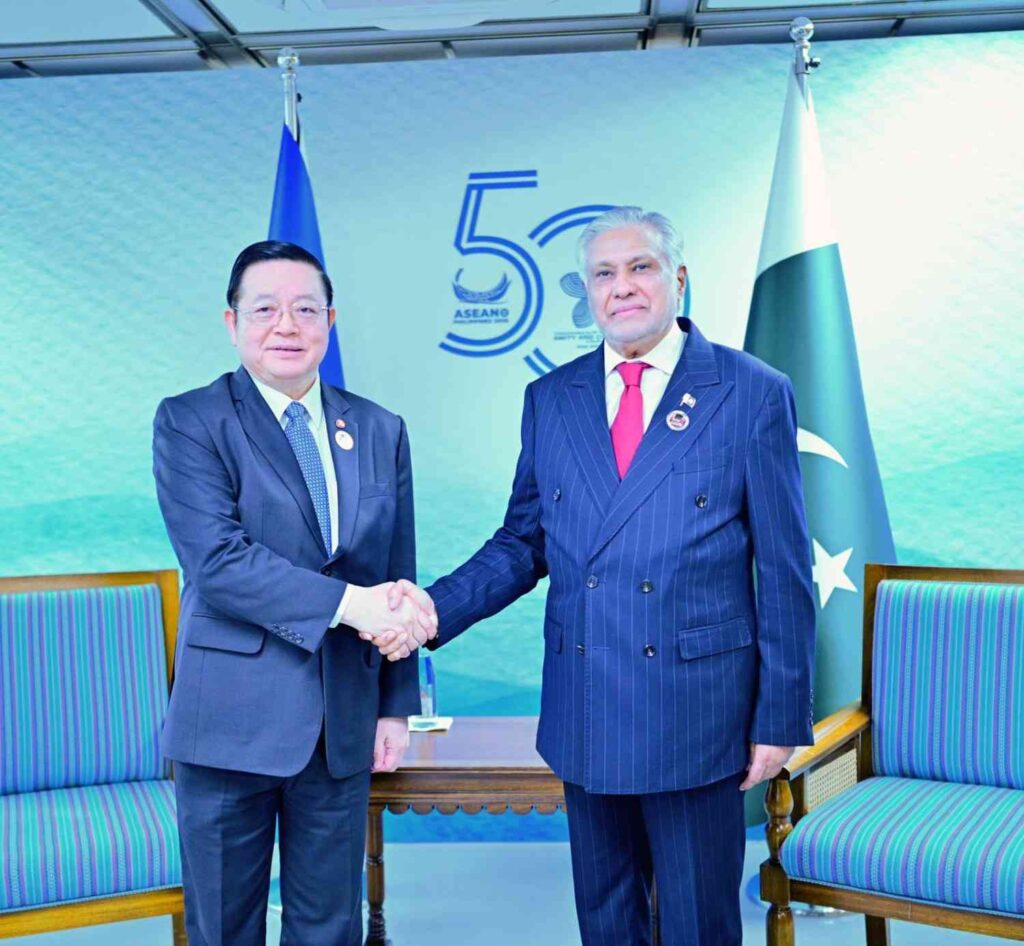
Meeting on the sidelines of the 33rd ASEAN Regional Forum (ARF), the Secretary-General of the Association of Southeast Asian Nations (ASEAN), Dr. Kao Kim Hourn, held detailed talks with Pakistan’s Deputy Prime Minister and Foreign Minister, Senator Mohammad Ishaq Dar. The bilateral engagement centered on advancing economic cooperation, enhancing regional trade corridors, and mitigating security flashpoints across Asia.
According to an official readout from the Deputy Prime Minister’s Office released in Islamabad, Dr. Kao commended Pakistan’s “constructive role in promoting dialogue and de-escalation” amid recent geopolitical turbulence across the broader Asian region. The ASEAN chief expressed confidence that sustained diplomatic engagements would serve as a foundation for long-term peace, stability, and sustainable economic growth.
In turn, Dar reaffirmed Islamabad’s intent to expand its diplomatic and commercial footprint across Southeast Asia, an economic market of over 680 million people that has increasingly become a centerpiece of Asian growth.
Deepening Trade and Connectivity Channels
While political and security dialogues formed the core of the Manila discussions, economic cooperation remained the overarching priority for both sides. The two leaders conducted a comprehensive review of existing bilateral linkages, focusing on actionable steps to boost bilateral trade, cross-border investment, logistical connectivity, and educational exchanges.
Dr. Kao highlighted Pakistan’s strategic geographic location—bridging South Asia, Central Asia, and the Arabian Sea—as a pivotal asset for regional trade networks. He noted a broad alignment of economic interests between the ten-member ASEAN bloc and Islamabad, pointing to substantial untapped potential in sectors ranging from digital commerce and agriculture to human resource development.
Pakistan-ASEAN Economic Snapshot
------------------------------------------------
Sectoral Dialogue Partner Status:   Since 1993
Total Bilateral Trade Volume:       ~$10.3 Billion (Peak)
Key Trading Partners in Bloc:       Malaysia, Indonesia, Thailand, Vietnam
Framework Document:                Practical Cooperation Areas (2024–2028)
------------------------------------------------
Pakistan has served as a Sectoral Dialogue Partner of ASEAN since 1993. Over the past decade, bilateral commerce between Pakistan and Southeast Asian economies reached approximately $10.3 billion at its peak, heavily driven by trade with major partners like Indonesia, Malaysia, Thailand, and Vietnam. However, economic analysts have long argued that trade levels remain below potential due to tariff barriers, high shipping costs, and a lack of direct institutional links.
To address these bottlenecks, Pakistan and ASEAN established the Practical Cooperation Areas (PCA) 2024–2028 framework during joint committee meetings in Jakarta. The initiative prioritizes joint projects in micro, small, and medium enterprises (MSMEs), digital technology, food security, and climate adaptation.
Navigating Complex Regional Security Dynamics
The Manila meeting comes at a delicate moment for Asian security, as multilateral gatherings under the ARF umbrella grapple with tense maritime disputes in the South China Sea, heightened cross-strait frictions, and broader global economic realignments.
During the session, Dr. Kao stressed the importance of ASEAN’s foundational principles—including peaceful settlement of disputes, mutual respect, and non-interference—as crucial mechanisms for maintaining equilibrium. Islamabad’s consistent participation in the ARF, the primary multilateral body dedicated to security dialogue in the Asia-Pacific, underlines its effort to position itself as a responsible security stakeholder rather than merely an observer.
Speaking to diplomats in Manila, foreign policy experts noted that Pakistan’s pursuit of broader Pakistan ASEAN cooperation forms part of a calibrated foreign policy recalibration aimed at diversifying partnerships beyond traditional diplomatic spheres. By strengthening ties with ASEAN nations, Islamabad seeks both economic stabilization through investment inflows and a balanced posture in regional security forums.
“The broad convergence between ASEAN’s outlook on open regionalism and Pakistan’s focus on geo-economics creates genuine space for institutional collaboration,” observed a senior Southeast Asian diplomat present at the summit venue. “However, moving from statements of intent to concrete tariff concessions and joint infrastructure investment remains the true benchmark of success.”
Road Ahead: Strategic Dialogue and Full Partnership Goals
A persistent long-term objective for Pakistani diplomacy has been elevating its current status from a Sectoral Dialogue Partner to a Full Dialogue Partner (FDP) within ASEAN—a designation held by powers such as China, Japan, India, and the United States.
While ASEAN maintains a general moratorium on adding new Full Dialogue Partners, both Dar and Dr. Kao agreed that maintaining steady, high-level institutional contact through joint sectoral committees will maintain positive momentum.
Both sides confirmed that follow-up ministerial meetings and business delegation exchanges will proceed in the coming months to operationalize the agreements discussed in Manila. As Southeast Asian economies continue to expand their manufacturing and trade reach, Islamabad views deepened cooperation with the bloc as an essential pillar of its long-term economic strategy.
FAQ
Q1: What was the primary outcome of the meeting between Pakistan’s Foreign Minister and the ASEAN Secretary-General?
A: The two leaders reaffirmed their commitment to strengthening bilateral relations, focusing on expanding trade, economic investment, regional connectivity, and security dialogue, while ASEAN praised Pakistan’s constructive role in regional peace and de-escalation.
Q2: What is Pakistan’s current official status within ASEAN?
A: Pakistan has been a Sectoral Dialogue Partner of ASEAN since 1993 and an active member of the ASEAN Regional Forum (ARF). Islamabad continues to pursue Full Dialogue Partner (FDP) status.
Q3: How large is the trade volume between Pakistan and ASEAN countries?
A: Trade volume between Pakistan and ASEAN member states has hovered around $8 to $10 billion annually, with major commercial activity concentrated across Malaysia, Indonesia, Thailand, and Vietnam.
Q4: What key framework guides Pakistan ASEAN cooperation in trade and security?
A: Bilateral engagement is guided by the ASEAN-Pakistan Practical Cooperation Areas (PCA) 2024–2028, which outlines joint initiatives across political-security, economic, digital, and socio-cultural sectors.

The Diplomatic Wire Desk is the institutional body responsible for all breaking news and analysis concerning international relations, foreign policy, and critical diplomatic initiatives. The Desk’s mandate is to provide objective and timely reports essential for a professional readership.