Pakistani authorities have arrested a local operative allegedly linked to an India-funded cyber disinformation campaign designed to undermine state institutions. The arrest highlights how low-cost, commercial social media management tools are being repurposed into potent geopolitical weapons across South Asia.
An investigation by Pakistani cybercrime officials has pulled back the curtain on a quiet but significant evolution in South Asian geopolitical friction: the commercialization of digital statecraft. Following the arrest of a suspect in Islamabad linked to an alleged India-funded online influence operation, authorities claim to have uncovered a network utilizing automated social media software to manufacture domestic unrest.
According to Pakistan’s Minister for Information and Broadcasting, Attaullah Tarar, the detained individual operated as a key operational node in a broader campaign aimed at attacking Pakistan’s sovereignty, armed forces, and democratic institutions. Investigators reported that financial trails trace back to foreign handlers in India, with much of the artificially amplified content targeting sensitive political developments, including protests organized by the banned Jammu Kashmir Joint Awami Action Committee in Azad Kashmir.
The case marks a critical turning point for national security analysts monitoring regional proxy conflicts. Rather than relying solely on foreign broadcasters, intelligence operatives, or high-profile political dissidents, the information warfare narrative is increasingly being outsourced to cheap, ubiquitous digital marketing infrastructure.
What Investigators Uncovered
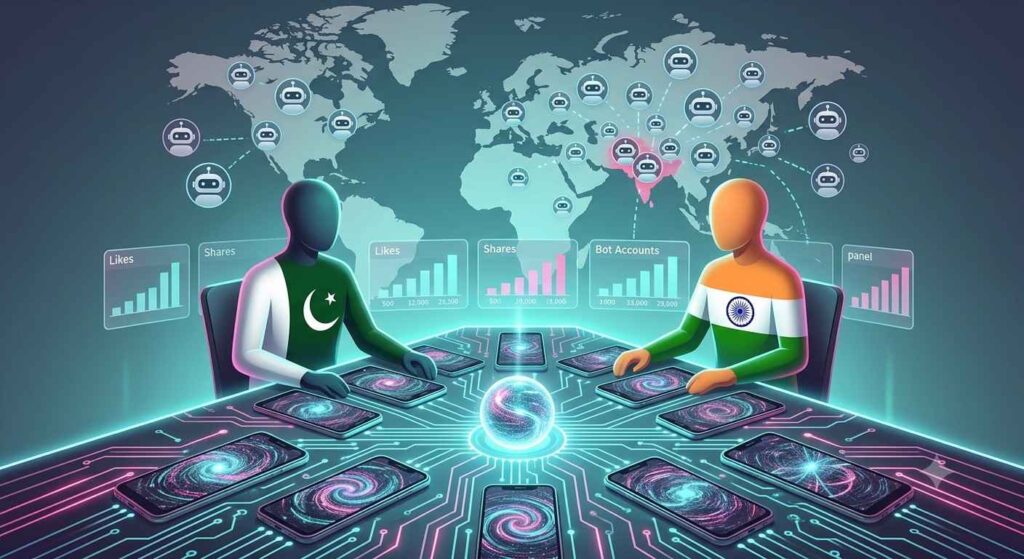
The mechanics of the operation relied heavily on Social Media Marketing (SMM) panels and automated bot farms—the exact same digital wholesale toolkits that small businesses, lifestyle creators, and e-commerce vendors use to artificially inflate follower counts and post views.
Federal Investigation Agency (FIA) officials noted that the suspect utilized localized digital marketing services as a front to buy and sell thousands of automated comments, likes, and shares for pennies per transaction. These manufactured interactions were then directed toward specific hashtags and narratives designed to give fringe political movements the illusion of widespread, organic public outrage.
Security analysts emphasize that the threat lies in the dual-use nature of this technology. SMM panels operate globally in a legal gray zone. In 2024, the US Federal Trade Commission (FTC) moved to ban the sale of fake metrics and fake followers, explicitly recognizing that artificial engagement severely distorts public trust and marketplace integrity. In South Asia, however, these same commercial plumbing networks are routinely weaponized for state-aligned political deception.
A Growing Pattern Across Borders
This week’s arrest in Islamabad is far from an isolated incident in the region’s cyber ecosystem. Independent disinformation research centers in Western Europe and North America have repeatedly flagged coordinated networks operating across both sides of the Radcliff Line.
Reuters and BBC reports have previously highlighted multiple platform enforcement actions taken by major social media companies—including Meta and X (formerly Twitter)—against network clusters originating in both Pakistan and India. In several instances, thousands of dormant or hijacked commercial accounts were suddenly rebranded overnight to push state-aligned geopolitical messaging during periods of high diplomatic tension.
What differentiates the latest Pakistan India cyber disinformation campaign is its reliance on domestic intermediaries. Foreign intelligence actors no longer need to maintain obvious foreign-based accounts that trigger automated platform spam filters. By funding freelance digital marketers, vloggers, and agency owners inside Pakistan, foreign actors can inject funding directly into local economies, exploiting young freelancers who may not even know the true identity of their primary client.
Why Commercialized Influence Matters
For Pakistan’s sprawling digital freelance economy—spurred by government initiatives like DigiSkills that have trained hundreds of thousands of youth in digital marketing—the situation presents an existential compliance challenge.
A standard digital marketing agency offering “engagement packages” operates on paper no differently from a legitimate commercial enterprise. The threshold between a routine commercial hustle and a foreign-funded strategic disinformation cell can be crossed with nothing more than an anonymous bank transfer or cryptocurrency transaction.
Cybersecurity experts point out that as long as digital marketing agencies operate without rigorous client-verification guidelines, the industry remains an ideal vector for hostile state intelligence operations.
Regulatory and Policy Challenges Ahead
Security officials in Islamabad face a delicate balancing act. Over-regulating the digital marketing sector risks suffocating a lucrative export economy for Pakistani freelancers. Conversely, ignoring the weaponization of engagement-for-hire platforms leaves the nation’s information space perpetually exposed to high-volume manipulation.
To effectively counter coordinated digital campaigns, analysts suggest three strategic pivots:
- Legal Reframing: Distinguishing clearly in legal frameworks between standard commercial fraud (buying likes for a small business) and state-backed political manipulation affecting national security.
- Industry Self-Regulation: Establishing mandatory “Know Your Customer” (KYC) standards for Pakistani digital marketing agencies and SMM panel operators handling high-volume campaign funding.
- Platform Accountability: Pressuring global social media platforms to accelerate real-time response mechanisms when coordinated bot networks manipulate localized trends during civil unrest.
As intelligence operations continue to migrate from traditional newsrooms to automated commercial algorithms, the line between casual social media engagement and strategic national defense has blurred. The arrest in Islamabad demonstrates that in modern statecraft, narrative warfare no longer requires a foreign agency—just an active credit card and a network of hired bots.
Frequently Asked Questions
Q1: What is a Pakistan India cyber disinformation campaign?
It refers to covert online operations where digital networks, automated bots, and paid influence channels are used by entities linked to either country to push targeted narratives, manipulate public opinion, and destabilize institutions across borders.
Q2: What are SMM panels and how do bot farms work in disinformation?
Social Media Marketing (SMM) panels are online platforms where users purchase bulk engagement, such as automated likes, retweets, comments, and views. In disinformation campaigns, bot farms use these panels to artificially amplify specific hashtags or false claims to make them appear organically popular.
Q3: What did Pakistan’s Information Minister Attaullah Tarar reveal about the recent arrest?
Information Minister Attaullah Tarar announced that authorities arrested an individual operating a social media influence node funded from India. The network allegedly generated coordinated campaigns against Pakistan’s state institutions and armed forces.
Q4: Are fake social media followers illegal?
While buying fake followers is prohibited under the terms of service of most social media platforms, legal enforcement varies. Regulatory bodies like the US Federal Trade Commission have moved to outlaw deceptive engagement metrics, while in Pakistan, cybercrime laws like PECA target covert manipulation, online fraud, and anti-state activity.

Khalid Minhas | Editor, Diplomatic Wire
A veteran journalist with three decades of comprehensive experience, Khalid Minhas has covered politics and international relations in depth throughout his career. He has also contributed to academia, teaching journalism and mass communication as a visiting faculty member at various universities in Pakistan. He holds an M.Phil in Mass Communication and is currently a Ph.D research scholar pursuing advanced studies in the field. He is also the author of the book America, Israel aur Islam, providing insightful analysis on the subject.