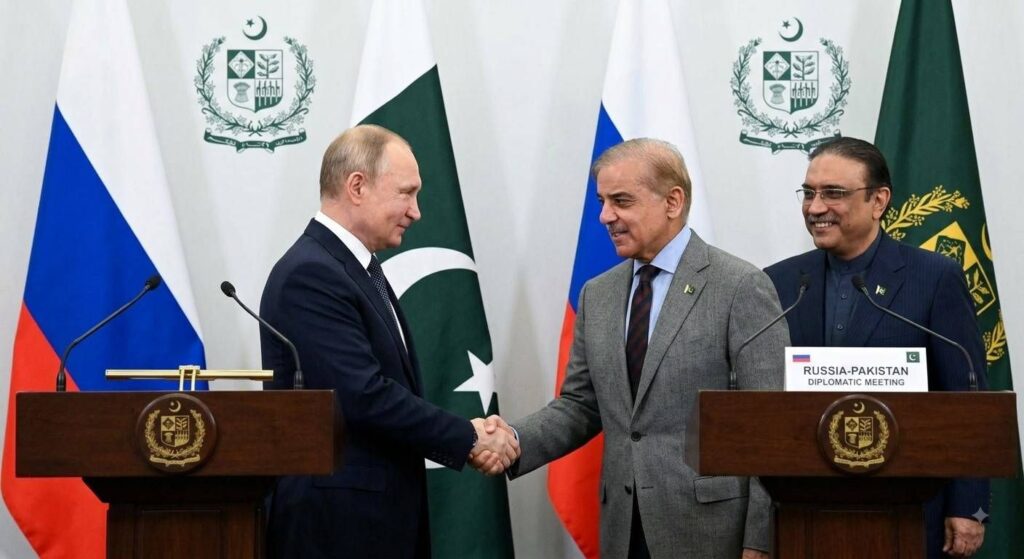
Russian President Vladimir Putin extended official congratulations to Pakistani President Asif Ali Zardari and Prime Minister Shehbaz Sharif on Friday as Pakistan marked its 79th Independence Day, underscoring what Moscow describes as a rapidly flourishing partnership between the two nations.
In a formal message released by the Kremlin on August 14, Putin commended the expanding scope of bilateral engagement, pointing to multi-faceted cooperation spanning trade, energy, regional security, and diplomatic dialogue. The statement reflects a broader geopolitical realignment in South Asia, where historical Cold War divides have steadily given way to pragmatism and economic mutual interest.
“Russia-Pakistan relations are developing with great success,” President Putin noted in his official correspondence. “Moscow and Islamabad maintain productive cooperation in the political, trade, economic, humanitarian and other spheres, while also working together on important regional and global issues.”
The Russian leader expressed confidence that joint initiatives would continue to strengthen the entire spectrum of the bilateral partnership, framing the relationship as a critical anchor for broader international stability and regional security.
A Diplomatic Pivot Decades in the Making
The warmth of the Kremlin’s message highlights a dramatic evolution in Russia Pakistan relations over the past two decades. Historically positioned on opposite sides of major global rivalries during the late 20th century, Moscow and Islamabad have systematically recalibrated their foreign policies since the early 2010s to build structured, cooperative channels.
A key turning point in this diplomatic trajectory came with Russia’s lifting of its long-standing arms embargo against Pakistan in 2014, followed by joint military and counter-terrorism exercises under the “Druzhba” (Friendship) banner. Since then, official exchanges between senior defense and government officials have become routine, reflecting mutual concerns regarding regional stability, particularly in neighboring Afghanistan.
Diplomatic observers note that the bilateral relationship has transitioned from cautious engagement to active economic and security alignment. Both nations share significant stakes in maintaining peace across Central and South Asia, preventing the spread of transnational militancy, and fostering regional infrastructure continuity.
Energy, Trade, and the Shanghai Cooperation Organisation
At the core of the contemporary Moscow-Islamabad relationship is a growing appetite for economic trade and energy infrastructure collaboration. Pakistan, facing severe economic headwinds and energy import pressures in recent years, has increasingly looked toward Russian crude oil and liquefied natural gas (LNG) as viable components of its national energy security matrix.
Furthermore, both nations participate actively within the framework of the Shanghai Cooperation Organisation (SCO), a regional bloc that has provided Islamabad and Moscow with a multilateral forum to coordinate on trade routes, counter-terrorism measures, and regional connectivity.
According to analysts monitoring Eurasian diplomatic dynamics, Russia’s interest in expanding ties with South Asian economies fits into a strategic push to diversify its diplomatic and economic relationships beyond traditional Western markets. For Pakistan, deepening ties with Moscow represents a commitment to a balanced, multi-vector foreign policy that maintains robust relations with Beijing and Western capitals while unlocking new avenues for trade across Eurasia.
“The language in President Putin’s message reflects a mature bilateral working relationship,” said a senior international relations analyst specializing in Eurasian diplomacy.
“It is no longer merely transactional; both capitals view each other as permanent stakeholders in the security and economic architecture of Eurasia.”
Navigating Complex Regional Dynamics
While bilateral warmth continues to build, both capitals navigate a nuanced regional matrix. Islamabad remains deeply integrated with Beijing through the flagship China-Pakistan Economic Corridor (CPEC), a key pillar of the Belt and Road Initiative. Concurrently, Russia maintains long-standing, deep-rooted defense and strategic ties with India, requiring Moscow to execute a delicate balancing act across the South Asian sub-continent.
Despite these layered external relationships, Moscow and Islamabad have demonstrated a shared preference for a multipolar international order, often coordinating positions in international forums, including the United Nations and the SCO. Russian officials have repeatedly emphasized that their engagement with Pakistan is independent of third-country relations and aimed strictly at bilateral stability and economic growth.
In his closing remarks to President Zardari and Prime Minister Sharif, President Putin wished the people of Pakistan “peace and prosperity,” reinforcing Moscow’s intention to maintain a steady, constructive trajectory with Islamabad in the years ahead.
Khalid Minhas | Editor, Diplomatic Wire
A veteran journalist with three decades of comprehensive experience, Khalid Minhas has covered politics and international relations in depth throughout his career. He has also contributed to academia, teaching journalism and mass communication as a visiting faculty member at various universities in Pakistan. He holds an M.Phil in Mass Communication and is currently a Ph.D research scholar pursuing advanced studies in the field. He is also the author of the book America, Israel aur Islam, providing insightful analysis on the subject.