As the May 6 deadline looms, President Trump signals a potential breakthrough in the US-Iran conflict via a simplified peace memorandum. While diplomatic channels in Islamabad and Beijing hum with activity, the White House has threatened a massive escalation if Tehran fails to commit within 48 hours.
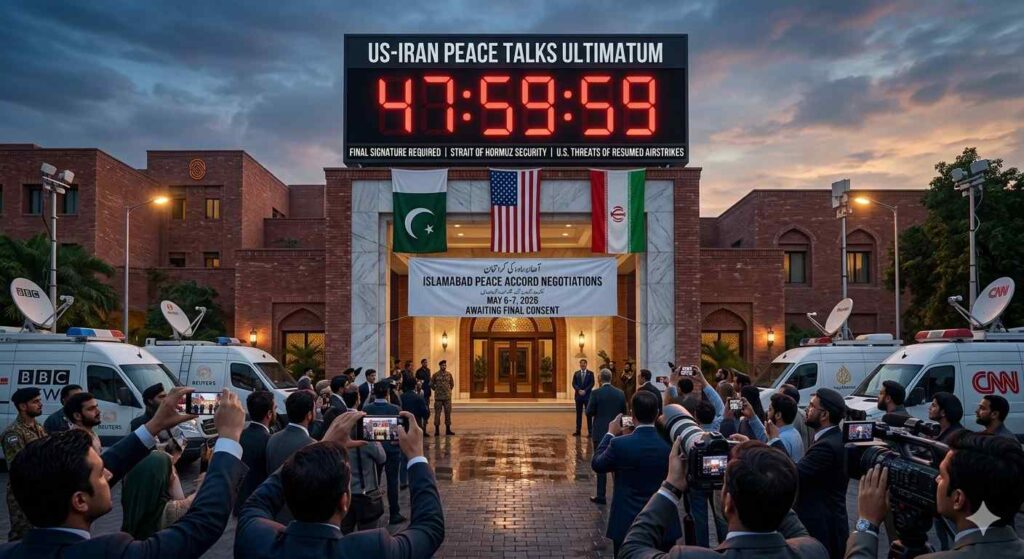
The Clock in the Persian Gulf
The trajectory of the Middle East hangs on a 48-hour countdown initiated by a Truth Social post. On Wednesday, May 6, 2026, the global community watched as President Donald Trump pivoted from the rhetoric of total destruction to the cautious optimism of a “one-page” resolution. The US-Iran conflict, which has ravaged regional stability since February, is currently balanced between a historic diplomatic pivot and what the White House calls a “bombing campaign of a much higher level.”
The stakes are personal, economic, and existential. For the first time in weeks, the administration has signaled that the “Epic Fury” military campaign could be permanently shelved. However, this olive branch is wrapped in steel; the President has made it clear that any hesitation from Tehran to sign the simplified memorandum will result in a return to full-scale hostilities.
Prioritizing the Strait: A Tactical Shift
A significant point of contention has long been the order of operations: does the nuclear program come first, or the maritime blockade? According to Al Jazeera, a pivotal shift appears to have occurred. For months, Tehran has insisted that the Strait of Hormuz maritime security must be addressed before they discuss deep nuclear concessions. New reports suggest the U.S. may have blinked—or at least squinted—at this demand.
The proposed “One-Page Memorandum” reportedly de-escalates the immediate maritime crisis first. This allows Iran a face-saving measure—reopening their economic lifeline—while the U.S. secures a verified pause in uranium enrichment. This “Hormuz-first” approach is a departure from the “Maximum Pressure” era, reflecting the urgent need to stabilize global oil markets which have been reeling under the weight of the Middle East oil crisis.
The Islamabad Channel and the Chinese Shadow
While the world watches the White House, the heavy lifting of this Trump Iran diplomacy is happening in the corridors of Islamabad. Pakistani mediators, acting as the primary bridge between the two belligerents, have reportedly been refining the language of the memorandum to ensure it is brief enough to satisfy Trump’s preference for “grand bargains” without being so vague that the Pentagon rejects it.
Simultaneously, the “China Factor” remains the wildcard. Foreign Minister Abbas Araghchi’s presence in Beijing this Wednesday suggests that Tehran is seeking a secondary guarantor. If China agrees to oversee the monitoring of the Strait of Hormuz, it provides a neutral third-party buffer that could prevent the naval skirmishes that have plagued the region since March.
Inside the 48-Hour Ultimatum
The President’s deadline isn’t just a rhetorical flourish; it’s a logistical one. Sources close to the Pentagon, cited by Reuters, indicate that carrier strike groups in the region are currently in a “maintenance pause” known as Project Freedom. If the 48-hour window expires without a signature, those assets are authorized to resume “Operation Epic Fury.“
The memorandum’s four pillars are stark:
- Reopening of the Strait: Removal of all sea mines and the cessation of U.S. naval intercepts of Iranian tankers.
- Enrichment Freeze: Immediate cessation of 60% uranium enrichment at Natanz and Fordow.
- Sanctions Suspension: Temporary waivers on Iranian oil sales to allow for “humanitarian stabilization.”
- Asset Thaw: The release of roughly $12 billion in frozen assets held in South Korean and Qatari accounts.
The Domestic Pressure Cooker
For the Trump administration, the clock is also ticking at home. As of May 2026, U.S. gas prices have become a primary political liability. A recent PBS NewsHour poll indicates a sharp decline in public support for a prolonged war of attrition. The “One-Page” deal is being marketed to the American public not as a diplomatic concession, but as a victory of “Art of the Deal” style leverage that brought a rogue state to its knees without a decade-long ground war.
However, critics in Washington warn that a one-page document may lack the technical rigors required to prevent Iran from “breakout” nuclear capability. Senatorial hawks have already signaled that any deal lacking “anytime, anywhere” inspections will be met with legislative resistance.
The Endgame Scenario
As the sun sets over Tehran this Wednesday, the city remains in a state of high alert. If the deal is signed, it marks the end of the most dangerous direct confrontation between the U.S. and Iran in forty years. If it fails, the “higher level” of intensity Trump promised could mean strikes on inland infrastructure, a move that many analysts fear would trigger a total regional conflagration involving Hezbollah and other proxies.
The world now waits for the next post, the next cable, and the final decision of the 48-hour gamble.
FAQ: Navigating the 48-Hour Deadline
Q1: What is the “One-Page Memorandum”? It is a simplified framework agreement proposed to end the immediate US-Iran conflict. It focuses on two urgent goals: reopening the Strait of Hormuz and halting Iranian nuclear enrichment, deferring more complex regional issues to later talks.
Q2: Why is the U.S. considering “Hormuz-first” negotiations? The Middle East oil crisis has driven global energy prices to record highs. By resolving the maritime blockade first, the U.S. can stabilize its domestic economy while still maintaining significant leverage over Tehran through remaining sanctions.
Q3: What role is Pakistan playing in these talks? Pakistan is the lead mediator. The Islamabad peace talks have served as the neutral ground where American and Iranian representatives can exchange documents through intermediaries to avoid the political fallout of direct face-to-face meetings.
Q4: What happens when the 48-hour deadline expires? If no agreement is reached, President Trump has authorized the resumption of “Operation Epic Fury,” which military analysts suggest would involve targeting Iran’s remaining air defense and missile sites with significantly more force than seen in February.
Q5: Is China supporting the U.S. peace plan? China is acting as a “silent partner.” While they haven’t officially endorsed the Trump plan, they are pressuring Iran to accept the maritime security terms to protect their own energy imports and prevent further regional instability.

Khalid Minhas | Editor, Diplomatic Wire
A veteran journalist with three decades of comprehensive experience, Khalid Minhas has covered politics and international relations in depth throughout his career. He has also contributed to academia, teaching journalism and mass communication as a visiting faculty member at various universities in Pakistan. He holds an M.Phil in Mass Communication and is currently a Ph.D research scholar pursuing advanced studies in the field. He is also the author of the book America, Israel aur Islam, providing insightful analysis on the subject.