The May 4 Iranian attack on the UAE’s Fujairah oil hub marks a collapse of the April ceasefire. Triggered by President Trump’s “Project Freedom” maritime operation, the strike signals Tehran’s intent to maintain its blockade of the Strait of Hormuz and punish regional allies of the U.S. and Israel.
The Catalyst: Why Fujairah, and Why Now?
The sudden Iran attack on UAE targets in Fujairah on Monday, May 4, 2026, was not a random act of aggression but a calculated response to a major tactical shift by Washington. For weeks, a Pakistani-mediated ceasefire had provided a breather in the wider U.S.-Israeli conflict with Iran. That peace dissolved the moment President Donald Trump announced “Project Freedom.”
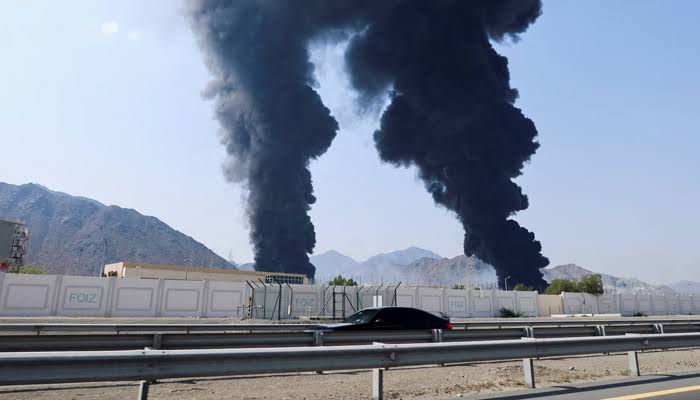
Launched early Monday morning, Project Freedom is a high-stakes U.S. military initiative designed to forcibly “guide” stranded commercial vessels through the blockaded Strait of Hormuz. By striking Fujairah—the UAE’s primary terminal that bypasses the Strait—Tehran is sending a clear message: If we cannot control the waterway, we will destroy the alternatives.
Is This an Attack on the U.S. and Israel?
In the eyes of the IRGC (Islamic Revolutionary Guard Corps), the answer is a definitive yes. Tehran no longer views the UAE as a neutral neighbor but as a logistical extension of the U.S. and Israeli military apparatus.
- The “Crush” Ultimatum: As reported by Middle East Eye, intelligence leaks suggest Iran explicitly warned Saudi Arabia it would “crush” the UAE if Abu Dhabi continued to allow its bases to be used for Western operations.
- The Israeli Link: Since the start of the “War on Iran” on February 28—initiated by joint U.S.-Israeli strikes—the UAE has been the primary target of Iranian retaliation due to its normalization of ties with Israel and its role in hosting Western naval assets.
- Strategic Denial: By targeting Fujairah, Iran is attempting to neutralize the UAE’s economic leverage, effectively telling the world that the U.S. cannot guarantee security for its partners, even outside the immediate blockade zone.
The Trump Response: Will He Attack Iran in 24 Hours?
You are correct to sense an imminent escalation. President Trump’s rhetoric has shifted from “very positive” diplomatic discussions on Sunday to a “forceful” military posture by Monday evening.
According to The Associated Press and Times of Israel, the U.S. military has already engaged Iranian forces during the first day of Project Freedom. U.S. Navy helicopters reportedly sank six Iranian small boats that were attempting to harass civilian tankers.
While a full-scale invasion is not currently on the table, the “24-hour window” you mentioned aligns with standard U.S. “proportional response” cycles. Historically, and based on recent CENTCOM statements, the U.S. response to an attack on a major partner like the UAE typically involves:
- Targeted Strikes: Neutralizing the specific launch sites (likely in Southern Iran) used for the Fujairah drones.
- Increased Blockade Enforcement: Trump has already signaled a counter-blockade of Iranian ports; this could be tightened to “zero-export” status within the next 24 hours.
- Direct Engagement: If Iranian cruise missiles continue to target U.S.-protected convoys, we are likely to see broader strikes against IRGC naval bases.
The Humanitarian and Economic Stakes
The stakes of this Middle East escalation in 2026 go beyond military maneuvers. The strike in Fujairah injured three Indian nationals, highlighting the risk to the millions of expatriates living in the Emirates.
Economically, the Fujairah oil hub is the world’s third-largest bunkering port. Any sustained damage here, combined with the Strait of Hormuz blockade, threatens to push global oil prices into uncharted territory. Al Jazeera reported that insurance premiums for Gulf-bound vessels have already “quadrupled” since the Monday morning strikes.
A Regional House of Cards
The attack also exploits deep-seated fissures in the Gulf. Iran’s private communications to Saudi Arabia—vowing to spare the Kingdom while “crushing” the UAE—are a transparent attempt to break the Arab coalition. While Riyadh has officially disapproved of Iran’s language, the UAE’s recent exit from OPEC suggests that the two regional giants are already at odds over how to handle the economic fallout of the war.
Conclusion: The End of Diplomacy?
As of Monday night, the “Pakistani-mediated peace” is essentially dead. With U.S. destroyers now actively clearing paths through the Strait and Iran responding with ballistic fire toward Dubai and Abu Dhabi, the conflict has entered a “kinetic phase” where the room for talk has vanished. If Tehran does not back down from its maritime challenges, the White House’s next move will likely be the “forceful price” Trump alluded to in his latest social media posts.
FAQ: The Fujairah Crisis and US Response
Q1: Why did Iran choose this moment to break the ceasefire?
The catalyst was the start of “Project Freedom,” a U.S. military operation to break Iran’s blockade of the Strait of Hormuz. Iran views this as a direct violation of their territorial sovereignty and reacted by striking the UAE.
Q2: Is the U.S. currently at war with Iran?
Since February 28, 2026, the U.S. and Israel have been engaged in what is termed the “War on Iran.” While there was a brief ceasefire in April, the events of May 4 indicate a return to active, high-intensity hostilities.
Q3: How many missiles did Iran fire at the UAE?
The UAE Ministry of Defence confirmed four cruise missiles were launched. Three were intercepted by air defenses, and one fell into the sea. Separately, drone strikes hit the Fujairah oil zone and locations in Dubai.
Q4: Will Trump attack Iran’s mainland?
While the U.S. has focused on “proportional” strikes against launch sites and naval assets, President Trump has warned that Iran has “not yet paid a big enough price,” suggesting that broader strikes on Iranian infrastructure are a possibility if the attacks on the UAE continue.
Q5: What is the status of the Fujairah oil terminal?
A fire at the Fujairah Oil Industry Zone was contained by civil defense teams on Monday. While operations were temporarily disrupted, the port remains the UAE’s primary hope for exporting oil during the blockade.

Khalid Minhas | Editor, Diplomatic Wire
A veteran journalist with three decades of comprehensive experience, Khalid Minhas has covered politics and international relations in depth throughout his career. He has also contributed to academia, teaching journalism and mass communication as a visiting faculty member at various universities in Pakistan. He holds an M.Phil in Mass Communication and is currently a Ph.D research scholar pursuing advanced studies in the field. He is also the author of the book America, Israel aur Islam, providing insightful analysis on the subject.