Pakistani Prime Minister Shehbaz Sharif on Friday strongly condemned recent Houthi missile strikes targeting Saudi Arabian airports, reiterating Islamabad’s firm security commitment under the Makkah Defence Alliance. The premier affirmed full support for Saudi sovereignty and self-defence following cross-border attacks that caused civilian casualties in Riyadh and Abha.
ISLAMABAD, Oct 9 — Prime Minister Shehbaz Sharif on Friday strongly condemned recent ballistic missile and drone attacks launched by Yemen’s Houthi rebels against Saudi Arabia, reiterating Pakistan’s unwavering commitment to the Gulf nation’s sovereignty and security under the trilateral Makkah Defence Alliance.
In an official statement published on social media platform X, the Pakistani prime minister highlighted that recent Houthi strikes targeted King Khalid International Airport in Riyadh and Abha International Airport, resulting in civilian fatalities and injuries. Shehbaz Sharif commended the vigilance and professionalism demonstrated by the Saudi armed forces and the Saudi-led coalition for successfully intercepting incoming ballistic missiles aimed at key infrastructure.
Expressing firm solidarity with Saudi leadership, Shehbaz Sharif reaffirmed that Pakistan’s dedication to Saudi Arabia’s territorial integrity remains resolute. He emphasized that Islamabad’s security guarantees fall under the broader umbrella of the Makkah Defence Alliance and align directly with recent decisions taken by its Strategic Political and Defence Committee.
The prime minister underscored that Pakistan fully supports Saudi Arabia’s fundamental right to self-defence against cross-border aggression and urged the Houthi movement to immediately halt all hostile operations. He stated that Pakistan would continue to stand shoulder-to-shoulder with the Kingdom in confronting security threats to its territorial stability.
The prime minister’s statement followed public claims by Houthi forces on Thursday asserting that they had launched a ballistic missile strike against Riyadh’s primary international aviation hub. The attack represents the latest in a series of direct strikes against Saudi facilities since hostilities expanded across the region.
On Wednesday, Saudi authorities confirmed that dual attacks targeting international transport hubs in Riyadh and Abha resulted in three deaths and left 36 people injured. In response, official media channels for the Saudi-led military coalition backing Yemen’s government announced that coalition forces identified and destroyed the ballistic missile launch platform responsible for targeting the Saudi capital.
Tensions across the Arabian Peninsula have escalated substantially following the Houthi movement’s declaration of a maritime blockade against Saudi Arabia. Houthi forces have repeatedly targeted commercial and naval vessels operating within critical shipping lanes in the Red Sea, triggering reciprocal strikes between coalition defense forces and rebel targets across coastal Yemen.
The escalation in cross-border air strikes coincides with intensifying ground combat in Yemen, where Houthi fighters controlling significant territory in the country’s northwest remain engaged against Saudi-backed government forces. Regional combat flared significantly in July after Houthi units seized strategic coastal tracts along the Red Sea.
Yemen’s internationally recognized government declared a major military counter-offensive this week, claiming its ground forces successfully cleared Houthi fighters from several strategic areas, including the vital Red Sea port city of Mocha. However, Houthi commanders maintain that their positions remain intact, while military sources cited by international news agencies indicate no major structural changes on the ground.
Operational Framework of the Makkah Defence Alliance
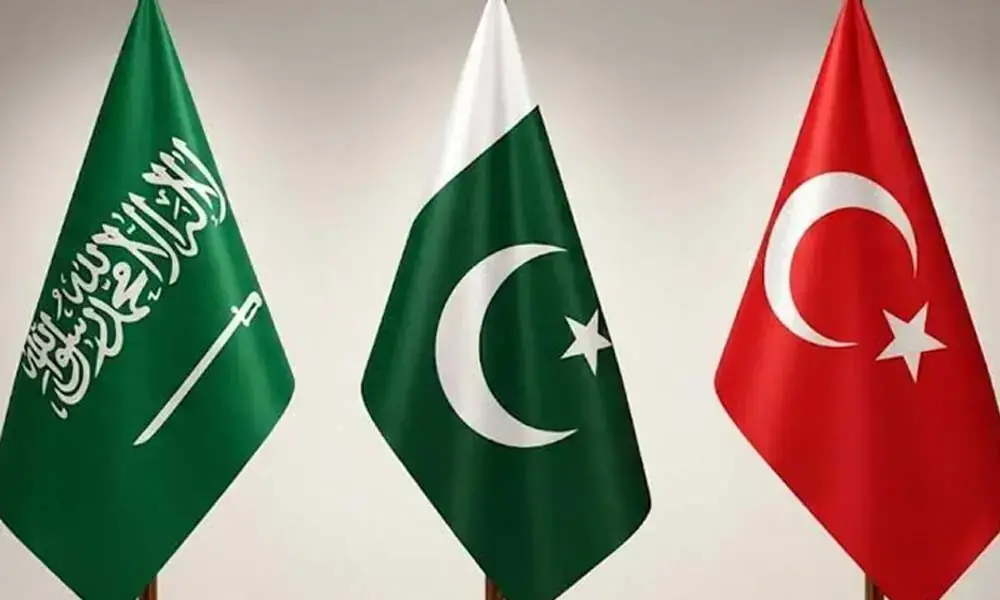
Against the backdrop of deteriorating regional stability, Pakistan has repeatedly renewed its military and diplomatic commitments to Saudi security. On August 7, Pakistan, Saudi Arabia, and Turkiye formally signed the mutual defense pact establishing the Makkah Defence Alliance to build collective deterrence across member states. The agreement stipulates that an attack against any single signatory state is treated as an attack against all members.
Following an emergency summit held in Riyadh on October 5, member states of the Makkah Defence Alliance approved the rapid deployment of military capabilities and defense elements within Saudi Arabia to reinforce strategic deterrence.
Addressing the scope of these deployments, Pakistani Defence Minister Khawaja Asif clarified during a televised appearance on Geo News program ‘Aaj Shahzeb Khanzada Kay Saath’ that while Pakistan and Turkiye maintain an active presence in the operational theater, direct combat operations are conducted exclusively by Saudi military personnel.
Asif reaffirmed that Pakistan remains fully prepared to meet its treaty obligations under the Makkah Defence Alliance both diplomatically and practically should regional hostilities expand further into Saudi territory. He emphasized that the alliance is purely defensive in structure, designed to preserve peace through collective deterrence rather than initiate offensive military actions.
The defense minister’s comments mirror earlier statements issued by senior military officials in Islamabad. On September 18, Inter-Services Public Relations (ISPR) Director General Lieutenant General Ahmed Sharif Chaudhry declared that Pakistan’s commitment to Saudi defense is unconditional, stating that Islamabad is prepared to go to any extent to safeguard the Kingdom’s sovereignty.
Read More: Mecca Joint Defence Agreement Reshapes Turkey Pakistan Defense Ties

The Diplomatic Wire Desk is the institutional news and analysis body of Diplomatic Wire, overseen by Founder and Editor Khalid Minhas. The Desk covers international relations, foreign policy, and critical diplomatic initiatives with objective, timely reporting for a professional readership.