South African jurist Navanethem “Navi” Pillay has been awarded the 2026 Nobel Peace Prize for her life’s work advancing international law, human rights, and accountability. The award follows her leadership of a UN commission on Gaza and coincides with Pakistan’s formal nomination of Donald Trump.
OSLO, Oct 9 — South African jurist Navanethem Navi Pillay was awarded the 2026 Nobel Peace Prize on Friday in recognition of her lifelong crusade to advance international law, hold global leaders accountable for war crimes, and protect human rights across some of the world’s most acute conflict zones.
Announcing the decision in Oslo, the Norwegian Nobel Committee praised the former United Nations High Commissioner for Human Rights for maintaining a firm moral compass throughout a distinguished career that spans more than six decades. Committee Chair Jørgen Watne Frydnes emphasized that Navi Pillay’s selection comes at a critical moment when global legal mechanisms and international judicial bodies face unprecedented political pressures and external attacks.
“This year’s laureate has been instrumental in ensuring that war crimes, crimes against humanity, and genocide are prosecuted,” Watne Frydnes stated during the formal announcement. He noted that in an era marked by expanding regional wars, international law is “no longer just a supplement to peace and security,” but an “absolute necessity” to preserve international order.
Decades of Human Rights Advocacy and Legal Landmarks of Navi Pillay
The Nobel jury highlighted Pillay’s long legacy of legal pioneerism, drawing a direct line from her early work during the South African apartheid era to her landmark roles on the global stage. As a young defense attorney in South Africa, Navi Pillay represented anti-apartheid activists, including Nelson Mandela and other political dissidents, fighting discriminatory legal structures and state abuse.
Navi Pillay later made history as a judge on the International Criminal Tribunal for Rwanda (ICTR), where Navi Pillay presided over pivotal trials that recognized sexual violence and rape as constituent acts of genocide under international humanitarian law. Pillay subsequently served as a judge on the International Criminal Court (ICC) before being appointed UN High Commissioner for Human Rights in 2008, a position she held for six years.
The committee commended Pillay for holding state officials accountable regardless of political stature, giving voice to victims of state-sponsored violence, and defending universal legal principles across changing political climates.
Gaza Genocide Report and Transatlantic Reactions
Most recently, Pillay served as chair of the United Nations Independent International Commission of Inquiry on the Occupied Palestinian Territory. Under her leadership, the commission issued a report concluding that Israel had committed acts of genocide during its military campaign in Gaza. While human rights organizations commended the findings, Israeli officials forcefully rejected the commission’s report, dismissing its conclusions as “scandalous”.
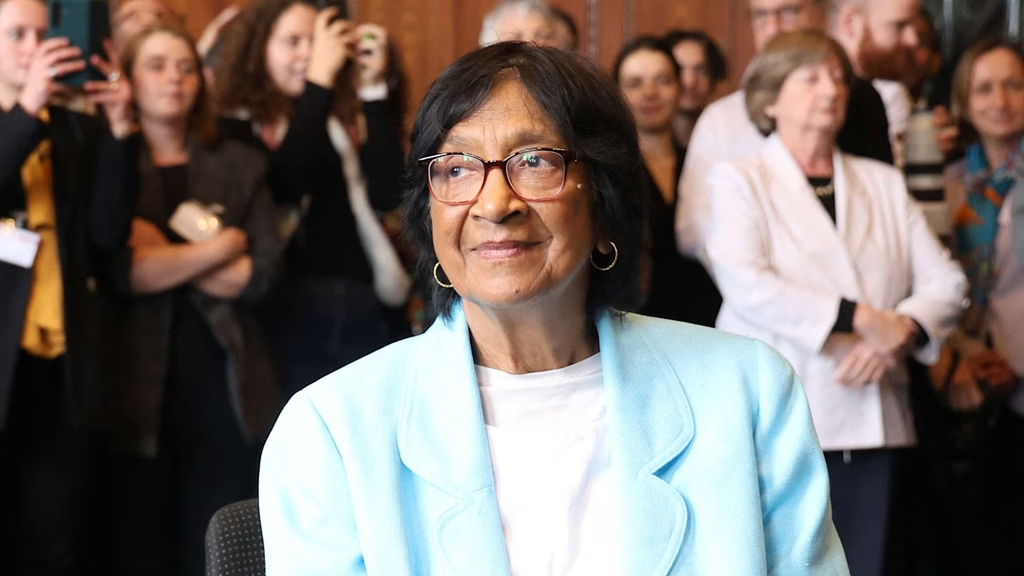
Pillay reacted to news of her award while attending an event in Nuremberg, Germany, where she was greeted with a standing ovation from human rights advocates. In a video published on social media platform X by Amnesty International Secretary General Agnès Callamard, Pillay expressed initial astonishment at the decision, remarking that as a judge she felt compelled to independently verify the news. She also offered a humorous nod to global political dynamics, telling the cheering audience, “If you clap a little bit more, I may share this prize with Trump”.
The committee’s decision is expected to draw scrutiny from Washington. US President Donald Trump, who returned to the White House in January 2025, has repeatedly criticized international judicial institutions and international courts. Since resuming office, Trump has publicly expressed an ambition to receive the Nobel Peace Prize for his foreign policy initiatives.
Nobel Recognition and Pakistan’s Nomination Ahead of Navi Pillay Win
The Nobel Committee’s announcement coincided with a high-profile diplomatic disclosure from Islamabad. Shortly before the Oslo ceremony, Pakistani Prime Minister Shehbaz Sharif revealed on X that Pakistan had formally nominated US President Donald Trump for the 2026 Nobel Peace Prize.
Prime Minister Shehbaz stated that Pakistan’s nomination was submitted in recognition of Trump’s “decisive diplomatic intervention and pivotal leadership” during a dangerous military standoff between Pakistan and India.
“In recognition of his outstanding contribution, Pakistan had nominated President Trump for the Nobel Peace Prize,” Prime Minister Shehbaz wrote, expressing hope that Washington’s efforts to prevent regional conflict would achieve global recognition.
The diplomatic recommendation stems from a major crisis that erupted in May 2025 following an attack on tourists in Indian-administered Kashmir. New Delhi attributed the attack to Pakistan without presenting public evidence, a charge Islamabad vehemently denied while calling for an impartial international investigation.
Tensions escalated rapidly when India launched cross-border air strikes targeting locations in Punjab and Azad Jammu and Kashmir on May 7, 2025. In response, Pakistani forces engaged Indian warplanes in aerial combat, downing eight aircraft and carrying out defensive counter-strikes on military airbases. With both nuclear-armed neighbors on the brink of wider war, high-level diplomatic intervention by President Trump on May 10 successfully brokered a ceasefire that remains in effect today.
Following the crisis, bilateral engagement between Washington and Islamabad has strengthened significantly. President Trump has frequently praised Prime Minister Shehbaz and Chief of Defence Forces and Chief of Army Staff Field Marshal Asim Munir, describing Shehbaz as a “terrific man” during an address to the United Nations General Assembly.
Award Mechanics and International Context
The Nobel Peace Prize carries a monetary award of 12 million Swedish crowns (approximately $1.2 million). The formal presentation ceremony will take place in Oslo on December 10, commemorating the anniversary of the death of Swedish industrialist and prize benefactor Alfred Nobel.
Pillay becomes the fifth Nobel laureate announced this week, following awards in Physiology or Medicine, Physics, Chemistry, and Literature. She succeeds Venezuelan opposition leader María Corina Machado, who received the Nobel Peace Prize in 2025.
In concluding its citation, the Norwegian Nobel Committee affirmed that Pillay’s lifelong dedication to the global rule of law serves as a vital reminder that international legal norms remain the bedrock of global peace and security.
Read More: Donald Trump Likely Nominee for 2026 Nobel Peace Prize Among 287 Candidates

The Diplomatic Wire Desk is the institutional news and analysis body of Diplomatic Wire, overseen by Founder and Editor Khalid Minhas. The Desk covers international relations, foreign policy, and critical diplomatic initiatives with objective, timely reporting for a professional readership.