Federal Minister for Finance Senator Muhammad Aurangzeb called for stronger Pakistan Netherlands business ties during a meeting with a Dutch commercial delegation in Islamabad. The discussions focused on expanding investment, boosting export-oriented growth, and leveraging public-private partnerships across key economic sectors.
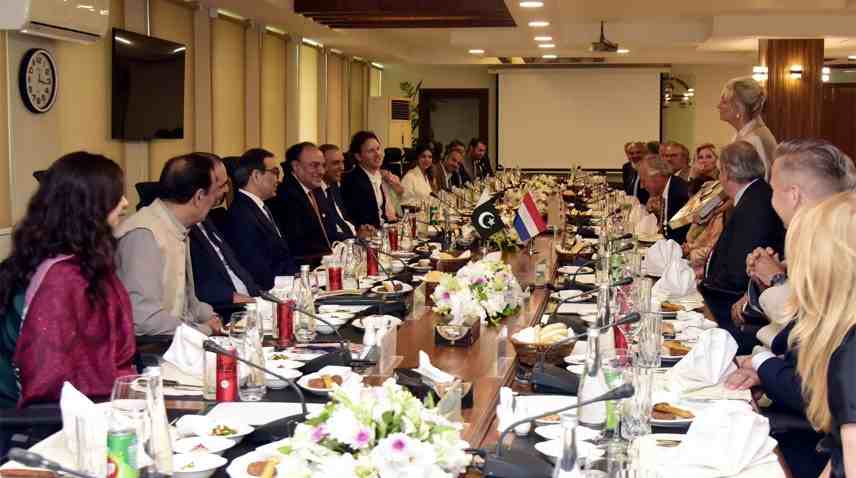
ISLAMABAD, Oct 9 — Federal Minister for Finance and Revenue Senator Muhammad Aurangzeb called on Friday for stronger Pakistan Netherlands business ties, urging commercial leaders from both nations to build direct enterprise-to-enterprise linkages and deepen bilateral economic cooperation.
Speaking at a luncheon hosted in Islamabad in honor of a visiting Dutch trade delegation led by the Founders Carbon Network (FCN), Aurangzeb emphasized that sustained engagement between private sector entities is essential to identify commercially viable projects, develop joint ventures, and bolster investor confidence. The delegation was accompanied by the Ambassador of the Kingdom of the Netherlands to Pakistan, Robert-Jan Siegert. The high-level gathering was attended by the Adviser to the Prime Minister on Privatisation Muhammad Ali, State Bank of Pakistan (SBP) Governor Jameel Ahmad, Commerce Secretary, and senior officials from the Ministry of Finance.
Aurangzeb briefed the visiting delegates on Pakistan’s macroeconomic outlook, stressing the government’s focus on transitioning from emergency economic stabilization toward sustainable, long-term growth. Pointing to the country’s strengthening external position, the finance minister highlighted that liquid foreign exchange reserves held by the central bank have reached a milestone of $21.4 billion, providing more than three months of import cover. He noted that maintaining reserve buffers and insulating the economy from external shocks remain central to the government’s strategy to anchor investor confidence and sustain growth.
According to the finance minister, the next phase of Pakistan’s economic agenda is structured around an export-oriented, productivity-driven, and employment-generating model. He stated that translating recent stabilization gains into capital formation, productive investments, and private-sector expansion requires sustained structural reforms. He underscored that mobilizing private domestic and foreign capital is critical to achieving these targets, framing the private sector as the primary engine of national economic development.
Expanding Pakistan Netherlands Business Ties Through Structural Reforms
Addressing the broader socio-economic landscape, Aurangzeb identified rapid population growth and climate change as two existential challenges confronting Pakistan’s economic sustainability and human development. He noted that Dutch technological expertise, agricultural innovation, and sustainable water management practices could play a constructive role in supporting Pakistan’s long-term development goals. He highlighted public-private partnerships (PPPs) as an important institutional mechanism to mobilize private capital, transfer technology, and execute viable projects across high-priority sectors.
Echoing the finance minister’s focus on private sector participation, Adviser to the Prime Minister on Privatisation Muhammad Ali reaffirmed Islamabad’s commitment to expanding the scope of commercial enterprise through state disinvestments and public-private frameworks. Ali explained that ongoing privatisation initiatives aim to reduce fiscal burdens, enhance operational efficiency, foster market competition, and create fresh entry points for foreign investors across key commercial domains.
SBP Governor Jameel Ahmad outlined the central bank’s regulatory measures designed to preserve macroeconomic stability, reinforce external-sector resilience, and ensure that financial sector reforms directly support productive economic activity. Ahmad highlighted targeted institutional efforts to facilitate trade, emphasizing the role of the Trade Facilitation Board in resolving regulatory bottlenecks, addressing trade barriers, and streamlining administrative coordination for commercial operators.
During the interactive session, members of the Dutch delegation shared their perspectives on Pakistan’s evolving business environment and prospects for commercial expansion. Delegates noted significant potential for expanding Pakistan Netherlands business ties in areas such as technology, sustainable energy, corporate agriculture, and logistics, highlighting the necessity of structured commercial dialogues to convert investor interest into concrete agreements.
The Netherlands represents a major trade partner for Pakistan within the European Union, with bilateral commerce supported by preferential trade access under the EU’s Generalised Scheme of Preferences Plus (GSP+) framework. Formal diplomatic relations between the two nations date back to 1948, built on long-standing commercial ties that historically originated with Dutch trading posts in Sindh during the 17th century. Over the decades, bilateral engagement has expanded to include significant Dutch corporate investments in dairy processing, consumer goods, energy infrastructure, and maritime services.
To consolidate these commercial avenues, Pakistani officials reaffirmed the government’s commitment to providing a stable, transparent, and enabling regulatory environment for international enterprises. Both sides expressed a mutual interest in utilizing established diplomatic and commercial frameworks to maintain continuous business-to-business engagement, promote Pakistan Netherlands business ties, and foster durable economic partnerships between Pakistani and Dutch firms.
Read More: Donald Trump Likely Nominee for 2026 Nobel Peace Prize Among 287 Candidates

The Diplomatic Wire Desk is the institutional news and analysis body of Diplomatic Wire, overseen by Founder and Editor Khalid Minhas. The Desk covers international relations, foreign policy, and critical diplomatic initiatives with objective, timely reporting for a professional readership.