
Pakistan Food Ministry Islamabad hosted Russian firm Schelkovo Agrohim to launch joint seed trials, technology transfers, and local agrochemical partnerships.
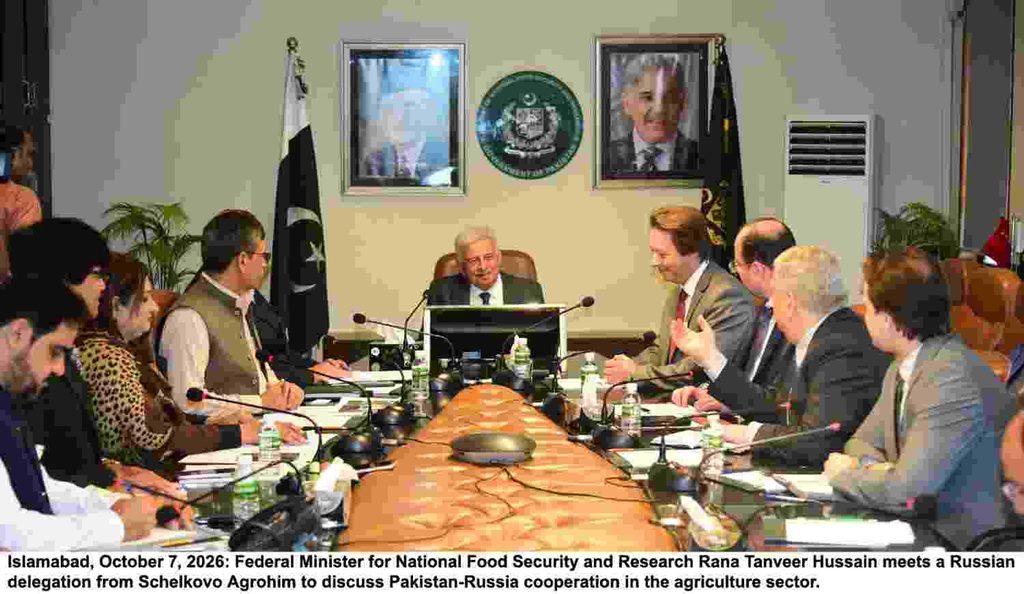
ISLAMABAD, Oct 07: Federal Minister for National Food Security and Research Rana Tanveer Hussain met on Wednesday with a delegation from the Russian agrochemical and seed enterprise Schelkovo Agrohim to negotiate bilateral initiatives spanning crop protection, seed technology, and direct investment.
The Russian delegation, accompanied by the Second Secretary and diplomats from the Embassy of the Russian Federation in Islamabad, held formal talks aimed at transitioning bilateral interactions from direct product imports to structural joint ventures and local production.
Shift Toward Technology Transfer and Local Research
Federal Minister Rana Tanveer Hussain stated that the Government of Pakistan seeks an agricultural partnership with Moscow that moves past purchasing finished inputs. He noted that the ministry aims to establish formal frameworks for technology transfer, local manufacturing, joint breeding endeavors, and capacity building for Pakistani agricultural scientists.
The minister pointed out that the country requires specialized seeds and inputs engineered for resilience against drought, plant diseases, insect pressure, and climate anomalies. Representatives from Schelkovo Agrohim briefed Pakistani officials on their portfolio, which includes crop protection products, specialized pesticide formulations, plant micronutrients, biological compounds, and micro-fertilizers. The delegation presented its research portfolio covering hybrid varieties of maize, wheat, sugar beet, rapeseed/canola, and sorghum, noting that the firm’s maize seed products are non-GMO.
Both sides identified targeted disease and pest control across cotton, rice, sugarcane, and vegetable crops as priority focal points for upcoming joint technical initiatives. The discussions examined non-traditional plant nutrition solutions designed to boost nutrient-use efficiency, which could potentially lower local farming reliance on imported chemical inputs such as Di-ammonium Phosphate (DAP) and conventional phosphorus fertilizers.
Institutional Evaluation and Field Trials
Addressing environmental stresses, Minister Rana Tanveer Hussain highlighted that climate disruptions pose a continuous challenge to national farm yields, making climate-tolerant, disease-resistant crop varieties a policy imperative. Pakistani agricultural officials specified that future collaboration must incorporate direct access to suitable Russian germplasm, joint breeding initiatives, local seed multiplication, traceability frameworks, and the setup of a dedicated Russian corporate entity or joint venture within Pakistan.
The Ministry of National Food Security designated the Pakistan Agricultural Research Council (PARC) and the National Agricultural Research Centre (NARC) as the official scientific platforms tasked with evaluating Russian technologies under local conditions. The minister affirmed that all foreign products must undergo strict scientific trials across Pakistan’s varied agronomic and soil zones before commercial release.
To maintain planting timelines, Pakistani officials proposed immediate field trials using Russian wheat seed lines ahead of the upcoming winter sowing season. These trials will assess yield potential, regional adaptability, and disease resistance under local field conditions. Technical teams will simultaneously evaluate hybrid wheat cultivars and related seed technologies.
Regulatory Engagement and Commercial Frameworks
Regarding pesticide regulation, the meeting noted that the Russian delegation had previously held working sessions with Pakistan’s Department of Plant Protection (DPP). DPP officials briefed the firm on statutory registration steps, product testing protocols, and laboratory study requirements. The delegates discussed the availability and potential establishment of internationally accredited testing facilities inside Pakistan.
Minister Rana Tanveer Hussain assured the Russian representatives that the ministry will facilitate B2B matching with local agribusinesses. Frameworks under consideration include joint ventures, local distribution, public-private partnerships, seed production, and research collaborations. The minister stated that Pakistan is diversifying its input supply chains, adding that Russian products could secure a substantial footprint in the domestic market if found scientifically effective and price-competitive.
To formalize the partnership, both parties agreed to negotiate a Memorandum of Understanding (MoU) or Letter of Intent (LoI). Immediate next steps include technical exchanges, regulatory testing of seed varieties, identifying local commercial partners, and designing research projects.
Background
The agricultural deliberations between Islamabad and Russian industry representatives occur against a backdrop of expanding bilateral economic engagement and structural adjustments in Pakistan’s agricultural sector.
Expanding Pakistan-Russia Economic Relations
Bilateral trade between Pakistan and the Russian Federation has grown steadily over recent years. Total trade volume surpassed $1 billion in 2023, driven by Pakistani wheat imports, energy commodities, and fertilizer procurement. In August 2026, both governments held trade consultations in Islamabad aimed at expanding agricultural machinery, fertilizer, and agrochemical supplies. Russian R&D delegations, including researchers from Schelkovo Agrohim, expanded engagement with Pakistani institutions in October 2026, holding academic and technical interactions at the University of Agriculture Faisalabad (UAF) prior to ministerial talks.
Federal Agricultural Research Infrastructure
The Pakistan Agricultural Research Council (PARC), operating under the Ministry of National Food Security and Research, serves as the premier national body conducting and coordinating agricultural research. Its primary field arm, the National Agricultural Research Centre (NARC) in Islamabad, evaluates plant genetic materials, conducts multi-locational seed trials, and verifies pesticide efficacy across Pakistan’s diverse agro-ecological zones before commercial registration can be granted by regulatory authorities.
Regulatory Oversight and Plant Protection
Pesticide evaluation and plant health regulations in Pakistan are governed by the Department of Plant Protection (DPP), a subsidiary department of the Ministry of National Food Security and Research. The DPP enforces the Agricultural Pesticides Ordinance and Rules, managing mandatory bio-efficacy trials, chemical analysis, registration dossiers, and safety protocols for imported and locally manufactured crop protection materials.

The Diplomatic Wire Desk is the institutional news and analysis body of Diplomatic Wire, overseen by Founder and Editor Khalid Minhas. The Desk covers international relations, foreign policy, and critical diplomatic initiatives with objective, timely reporting for a professional readership.