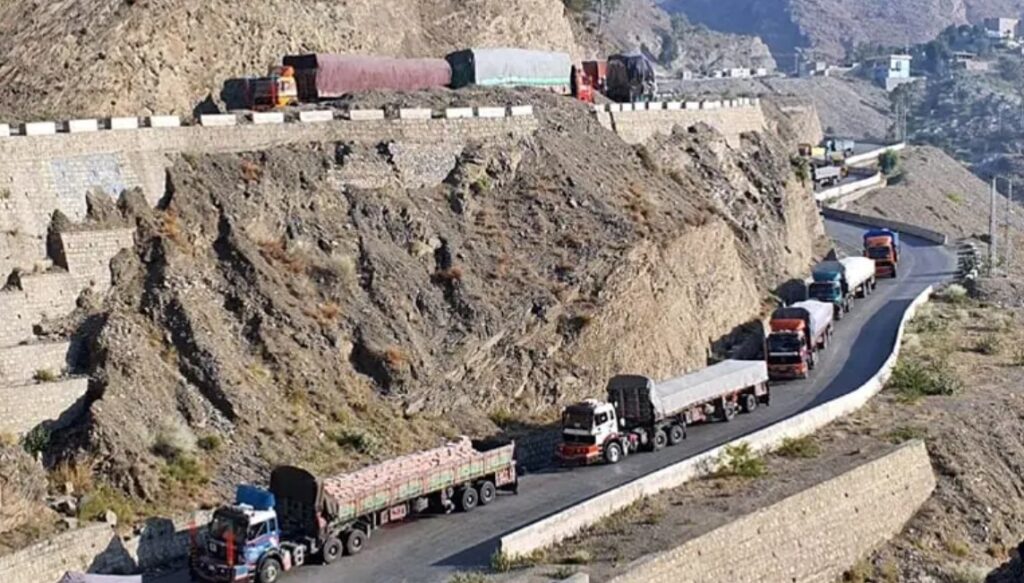
ISLAMABAD: Pakistan on Friday made it clear that the resumption of trade with Afghanistan hinges on the Taliban regime ending cross-border terrorism and halting support for militant groups operating against Pakistan. The Foreign Office (FO) said that the continued closure of border crossings, including Torkham and Chaman, was a direct consequence of the deteriorating security situation emanating from Afghan soil.
FO spokesperson Tahir Hussain Andrabi, during his weekly media briefing, said that the “onus of delay” in reopening the border rests entirely with the Afghan Taliban authorities. He noted that Pakistan had long attempted to keep trade insulated from security tensions but added that the threshold of patience had now been crossed.
Pakistan Afghanistan trade: Trade Halt and Economic Consequences
Pakistan and Afghanistan’s bilateral trade, estimated between $1.6 billion and $1.8 billion in 2023-24, has remained suspended since mid-October following deadly clashes between Pakistani forces and Taliban fighters. The closures have imposed heavy losses on Afghan businesses, estimated at $2.5 million per day, while also threatening Pakistan’s own annual transit revenues of nearly $1 billion.
With no clear sign of reopening, Kabul has increasingly shifted reliance to Iranian routes, including the port of Chabahar, raising concerns about long-term erosion of Pakistan’s role as Afghanistan’s major transit corridor.
Security Threats and FO’s Concerns
The FO spokesperson said Pakistan had suspended trade because of the alleged support being extended to what Islamabad labels as Fitna-al-Khawarij (FAK) and Fitna-al-Hindustan (FAH) — terms used for militants belonging to the banned Tehreek-i-Taliban Pakistan (TTP), the Balochistan Liberation Army (BLA), and other groups Pakistan accuses of being backed by India.
Andrabi recalled that Pakistani trade posts were attacked from the Afghan side on November 10 and 15, calling the threat “existential.” He stressed that Pakistan cannot allow trade to continue “as if it were a licence to kill Pakistanis from Afghan soil.”
He rejected the notion that economic considerations should override security concerns. “Can you put a price tag on a Pakistani life?” he asked, adding that families of terror victims cannot be told that trade should continue at the cost of human lives.
Regional Projects at Stake
The FO also warned that regional infrastructure projects such as the TAPI gas pipeline and the CASA-1000 electricity transmission project depended heavily on a change in the Taliban’s conduct. Andrabi said the success of these multibillion-dollar projects is contingent on Kabul halting support for militant outfits and ensuring that Afghan territory is not used for attacks inside Pakistan.
“This is the central denominator,” he said. “The Taliban regime must stop backing groups like FAK, FAH and their affiliates if regional cooperation is to move forward.”
Turkish Mediation Efforts
The spokesperson said that the long-anticipated visit of a high-level Turkish delegation — including Turkey’s foreign minister, defence minister and intelligence chief — was still being scheduled. Ankara had announced earlier this month that the delegation would travel to Islamabad to revive mediation efforts after the third round of Pakistan-Afghanistan talks in Istanbul ended without an agreement on November 7.
“This visit has not yet taken place. It is being scheduled, and such high-level travel plans take time,” Andrabi clarified. He dismissed suggestions that Pakistan’s lack of cooperation was causing delays.
He said it was too early to comment on other mediation proposals, including those from Russia and Iran, though Pakistan appreciates the efforts of all friendly states.
The Way Forward
Pakistan maintains that border crossings will reopen only when the Afghan Taliban takes decisive action against militant groups using Afghan territory to launch attacks. Andrabi acknowledged the losses Pakistani traders are facing but insisted that national security must come first.
“We are cognisant of the losses to traders, but we cannot allow our people to be killed indiscriminately,” he said.
Khalid Minhas | Editor, Diplomatic Wire
A veteran journalist with three decades of comprehensive experience, Khalid Minhas has covered politics and international relations in depth throughout his career. He has also contributed to academia, teaching journalism and mass communication as a visiting faculty member at various universities in Pakistan. He holds an M.Phil in Mass Communication and is currently a Ph.D research scholar pursuing advanced studies in the field. He is also the author of the book America, Israel aur Islam, providing insightful analysis on the subject.