In a significant development for regional humanitarian operations, Pakistan has officially resumed the clearance of vital humanitarian consignments bound for Afghanistan, ending nearly two months of halted cross-border cargo activity. This controlled reopening marks a crucial step toward ensuring uninterrupted aid delivery to millions of Afghans dependent on international support.
Background: Complete Suspension of Afghan Transit Trade Since October
On October 12, Pakistan enforced a full suspension of customs clearance for exports, imports, and all Afghan Transit Trade (ATT) cargo at major border crossings, including:
- Torkham
- Ghulam Khan
- Kharlachi
- Angoor Adda
Shortly after, on October 15, the Chaman border was also closed for all ATT-related cargo movements.
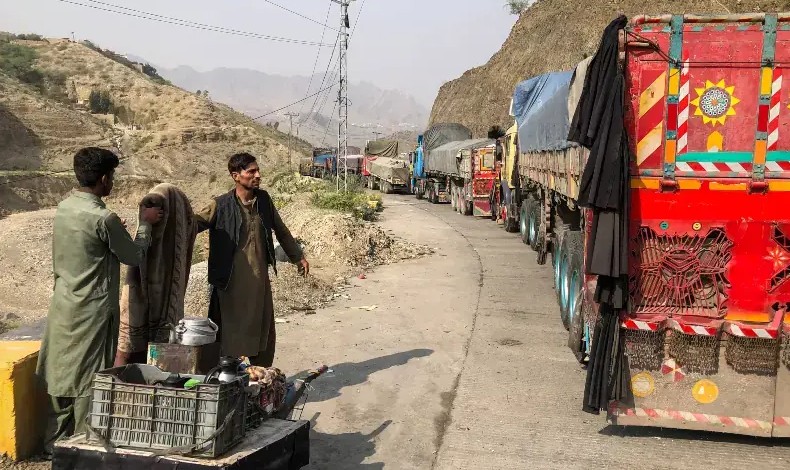
The abrupt halt came due to internal security, regulatory, and documentation concerns—leaving thousands of cargo vehicles stranded and severely impacting humanitarian supply routes into Afghanistan.
Humanitarian Cargo Begins Clearance After Official Directives
A formal notification was sent to both the Federal Board of Revenue (FBR) and the Directorate General of Transit Trade, directing them to immediately start processing consignments belonging to three major United Nations agencies. This clearance covers humanitarian cargo movement through Chaman and Torkham, the two busiest transit gateways between Pakistan and Afghanistan.
Breakdown of the First Phase: 143 Containers Cleared
The reopening is being implemented in phases, beginning with the clearance of 143 containers of life-saving goods:
- 67 containers of food assistance from the World Food Programme (WFP)
- 74 containers of children’s supplies from UNICEF
- 2 containers of healthcare and family support items from UNFPA
These shipments are essential for Afghanistan’s vulnerable populations, especially ahead of harsh winter months when food insecurity and medical shortages intensify.
Officials confirm that the move follows directives from the Foreign Ministry, which consulted closely with the UN Resident Coordinator in Pakistan to ensure smooth and secure operations.
Three-Stage Cargo Movement Protocol Rolled Out
According to the official letter, Pakistan has adopted a three-stage cargo movement framework for humanitarian shipments:
1. Food Shipments
The first stage prioritizes food aid, including essential rations, infant nutrition, and emergency food packages sent by WFP.
2. Medicine and Medical Equipment
The second phase allows the movement of pharmaceuticals, diagnostic equipment, emergency medical kits, and maternal health supplies—primarily for UNICEF and UNFPA health programs.
3. Education Services Shipments
The final phase will facilitate consignments containing:
- Educational kits
- School tents
- Stationery
- Teaching materials
These resources are crucial for Afghanistan’s fragile education system, where millions of children remain out of school.
UN agencies are expected to submit updated consignment lists, which will be cleared in subsequent stages after documentation validation.
Transit Trade Procedures Reinforced Under APTTA Framework
The government has reiterated that all movements will proceed strictly under the Afghanistan–Pakistan Transit Trade Agreement (APTTA) and established ATT rules.
Customs authorities have been instructed to ensure:
- Full compliance with original manifests
- Strict security checks
- Oversight of onward transportation
- Verification through cross-border tracking systems
This approach aims to prevent misuse of transit provisions while ensuring humanitarian corridors remain open.
Border Congestion Continues: Nearly 500 Vehicles Still Stranded
Despite the partial reopening, transit congestion persists. Current estimates reveal:
- 495 vehicles queued for crossing at Torkham and Chaman
- 412 stranded at Chaman
- 83 delayed at Torkham
Truck drivers and customs workers have spent weeks waiting with limited facilities, impacting livelihoods and delaying critical supplies.
Officials emphasize that only humanitarian ATT cargo is being cleared at this stage, and routine commercial trade has not been restored.
Impact on Afghanistan: Humanitarian Lifeline Reconnected
The clearance of humanitarian cargo offers immediate relief for millions in Afghanistan who depend on UN agencies for:
- Food security
- Primary healthcare
- Maternal and child support
- Educational continuity
WFP has already warned that Afghanistan faces one of the world’s most severe food crises, with over 15 million people in need of urgent food assistance. The resumed flow of supplies will strengthen emergency response efforts.
Pakistan’s Transit Trade Landscape in FY 2024–25
During the fiscal year 2024–25, Pakistan recorded:
- $1.012 billion in transit trade imports
- 42,959 total containers processed under ATT
The temporary shutdown significantly impacted commercial activity, logistics operations, and border economies reliant on cross-border trade.
Future Outlook: Controlled, Document-Verified Humanitarian Movement
Senior officials confirm that:
- More UN consignments will be processed in phases.
- Only verified humanitarian cargo will move.
- Full commercial transit trade remains suspended until further government review.
The controlled reopening reflects Pakistan’s balancing act—ensuring security compliance while honoring international humanitarian commitments.
Conclusion
With humanitarian needs in Afghanistan rising sharply, Pakistan’s decision to allow the movement of 143 UN containers marks a crucial intervention. Although routine trade remains halted, the systematic reopening of humanitarian corridors ensures that essential food, medicine, and educational supplies reach Afghans during a critical period.
Continued coordination between Pakistan, UN agencies, and cross-border authorities will be vital for sustaining this fragile lifeline.

Khalid Minhas | Editor, Diplomatic Wire
A veteran journalist with three decades of comprehensive experience, Khalid Minhas has covered politics and international relations in depth throughout his career. He has also contributed to academia, teaching journalism and mass communication as a visiting faculty member at various universities in Pakistan. He holds an M.Phil in Mass Communication and is currently a Ph.D research scholar pursuing advanced studies in the field. He is also the author of the book America, Israel aur Islam, providing insightful analysis on the subject.