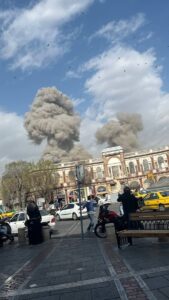
 TEHRAN / TEL AVIV — The United States and Israel initiated a massive, coordinated aerial campaign against the Islamic Republic of Iran in the early hours of Saturday, February 28, 2026. This “preemptive” operation follows the total collapse of high-stakes diplomatic negotiations in Geneva just 48 hours prior. Multiple explosions have been confirmed across Tehran, with strikes targeting the IRGC command structure and nuclear infrastructure. U.S. President Donald Trump confirmed the commencement of “major combat operations” to neutralize what the administration termed an “existential and imminent threat.”
The Nut Graf
The transition from the negotiating table to active kinetic engagement represents a definitive failure of the “Oman-mediated” diplomatic track. By issuing a “zero-enrichment” ultimatum that Tehran viewed as a demand for total capitulation, the U.S.-Israeli alliance established a diplomatic tripwire for this offensive. This escalation shifts the regional paradigm from “maximum pressure” to a direct military effort to decapitate the Iranian regime’s strategic capabilities and permanently dismantle its nuclear program.
From Failed Diplomacy to “Midnight Hammer II”
The path to today’s strikes was paved by the breakdown of the third round of nuclear talks in Geneva on February 26, 2026. During these sessions, U.S. negotiators, led by Special Envoy Steve Witkoff, presented a list of non-negotiable demands that official sources stated were “essential for global security.” These demands included:
* Permanent Dismantlement: The immediate destruction of the Fordow and Natanz enrichment facilities.
* Stockpile Seizure: The transfer of all enriched uranium (including 60% purity) to third-party custody.
* Universal Oversight: The removal of all “sunset clauses” and the granting of “anytime, anywhere” access to the IAEA.
Consequently, Iranian Foreign Minister Abbas Araghchi rejected the proposal as “unrealistic and an affront to national sovereignty.” The expiration of a 15-day compliance window, set by Washington on February 19, provided the final justification for the joint military action.
Kinetic Execution and Targets
According to the Israel Defense Forces (IDF) and the U.S. Department of Defense, the first wave of strikes utilized the USS Gerald R. Ford and USS Abraham Lincoln carrier strike groups. Reports from the Fars News Agency indicate that the coalition targeted:
* Command and Control: Administrative hubs in Tehran’s Jomhouri district and residences of senior IRGC commanders.
* Nuclear Sites: Hardened facilities at Isfahan and Karaj, previously targeted during the June 2025 “Operation Midnight Hammer.”
* Naval Assets: Iranian missile boats and port infrastructure in the Persian Gulf.
Furthermore, Israel has declared a 48-hour national state of emergency, and Iraq has closed its airspace as a precaution against regional spillover.
Strategic Outlook
* Asymmetric Retaliation: With diplomatic channels closed, Iran is expected to activate the “Axis of Resistance.” Hezbollah and Iraqi militias will likely launch multi-front drone and missile barrages against Israeli population centers and U.S. regional bases.
* Energy and Trade Volatility: The threat to the Strait of Hormuz is now critical. Any Iranian attempt to block this waterway will cause an unprecedented spike in global oil prices and disrupt the CPEC energy corridor.
* Regime Stability: The coalition’s focus on “decapitation strikes” aims to fracture the IRGC’s internal control. However, the lack of a diplomatic exit ramp may force the Iranian leadership into a “total war” posture to ensure its survival.

Khalid Minhas | Editor, Diplomatic Wire
A veteran journalist with three decades of comprehensive experience, Khalid Minhas has covered politics and international relations in depth throughout his career. He has also contributed to academia, teaching journalism and mass communication as a visiting faculty member at various universities in Pakistan. He holds an M.Phil in Mass Communication and is currently a Ph.D research scholar pursuing advanced studies in the field. He is also the author of the book America, Israel aur Islam, providing insightful analysis on the subject.