The traditional nuclear equilibrium in South Asia is undergoing a profound structural change. According to the newly released Stockholm International Peace Research Institute (SIPRI) Yearbook 2026, regional powers are no longer just expanding their nuclear arsenals—they are fundamentally altering their operational readiness.
For the first time in peacetime history, India is reported to have placed a portion of its nuclear stockpile on active, deployed status. This development, coupled with a massive expansion in China’s nuclear inventory, marks a critical pivot point for regional security dynamics involving New Delhi, Beijing, and Islamabad.
India’s Peacetime Shift: What 12 Deployed Warheads Mean
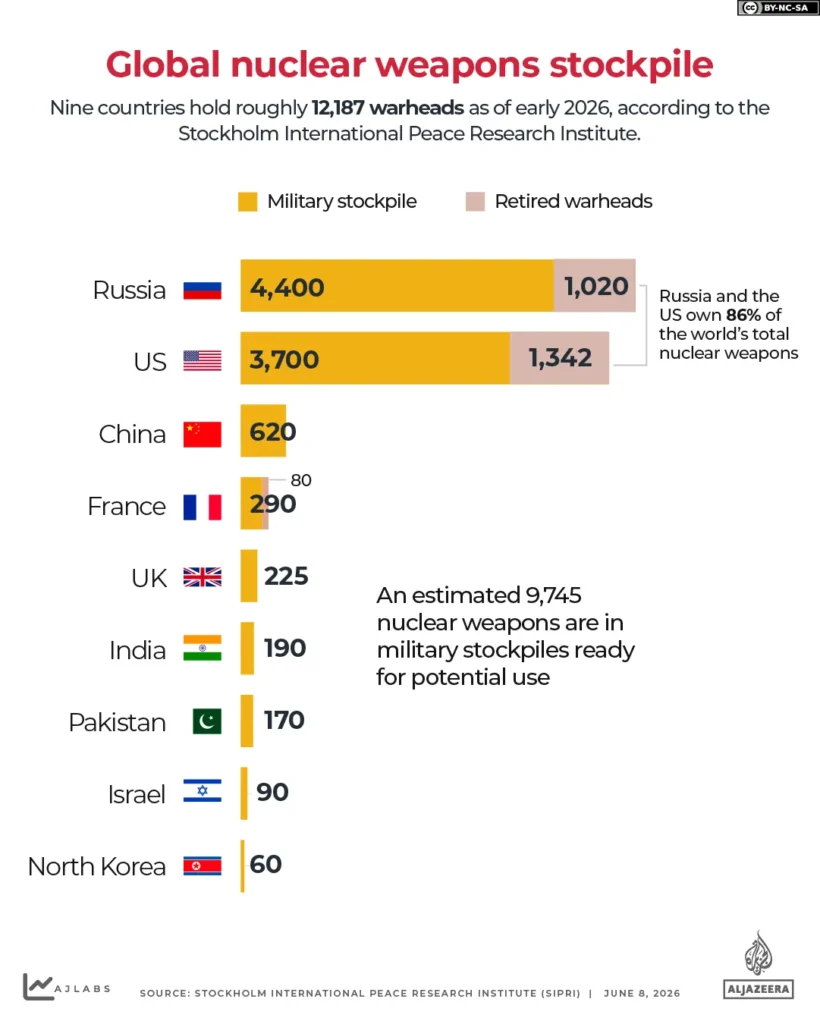
The most striking revelation in the SIPRI report 2026 is that India now possesses 12 deployed nuclear warheads.
Historically, India kept its entire arsenal under centralized military storage, physically separated from delivery systems like ballistic missiles or aircraft. SIPRI’s latest assessment indicates a shift toward mating warheads with operational delivery systems or positioning them directly at active military bases during peacetime.
While a minor operational fraction of India’s total 190 warheads, this development signals an enhanced focus on high-readiness deterrence. Analysts view this tactical shift as an effort to ensure a highly credible, rapid-response second-strike capability—particularly via the sea-based leg of India’s nuclear triad.
Regional Nuclear Tally: India vs. China vs. Pakistan
The Asian nuclear landscape has grown increasingly asymmetrical. The data from the SIPRI Yearbook 2026 outlines a distinct separation between total stockpiles and active peacetime deployment across the three neighboring states:
| Country | Total Estimated Inventory | Deployed Warheads (Peacetime) | Focus of Modernization |
|---|---|---|---|
| China | 620+ | 24 | Rapid stockpile expansion, ICBM silos, and a full nuclear triad |
| India | 190 | 12 | Long-range ballistic missiles (Agni series) and SSBN sea deterrence |
| Pakistan | 170 | 0 | Multiple Independent Targetable Re-entry Vehicles (MIRVs) |
China Crosses the 600-Warhead Threshold
Beijing continues its aggressive nuclear expansion, with its total inventory surging past the 600-warhead mark in 2026 (up from roughly 500 in 2024). While China maintains 24 deployed warheads, its massive infrastructure growth—including new intercontinental ballistic missile (ICBM) silo fields—indicates a transition toward a much larger, highly diversified strategic force capable of matching global peers.
Pakistan’s Strategic Focus: Quality Over Peacetime Deployment
Islamabad’s total stockpile stands at an estimated 170 nuclear warheads, remaining slightly below India’s total. Notably, SIPRI lists zero deployed warheads for Pakistan during peacetime, indicating that Islamabad adheres to its traditional stance of keeping warheads disassembled and under strict central custodial control. Pakistan’s current modernization emphasizes upgrading delivery flexibility, such as perfecting Multiple Independently Targetable Re-entry Vehicle (MIRV) capabilities via the Ababeel missile system to counter regional missile defense shields.
The Strategic Catalyst: Moving Beyond Pakistan
The data underscores a clear shift in New Delhi’s defense planning. While India’s nuclear doctrine was historically calibrated around a symmetric deterrence posture with Pakistan, its current long-term modernization efforts are visibly pivoting toward China.
The development of longer-range systems like the Agni-V, alongside the operational deployment of ballistic missile submarines (SSBNs) like the INS Arihant and INS Arighat, gives India the reach necessary to establish credible deterrence across the broader regional theater.
Key Takeaway: Despite these operational shifts reported by SIPRI, India has not formally amended its core nuclear doctrine. New Delhi officially maintains its strict “No-First-Use” (NFU) commitment and a policy of Credible Minimum Deterrence.
Khalid Minhas | Editor, Diplomatic Wire
A veteran journalist with three decades of comprehensive experience, Khalid Minhas has covered politics and international relations in depth throughout his career. He has also contributed to academia, teaching journalism and mass communication as a visiting faculty member at various universities in Pakistan. He holds an M.Phil in Mass Communication and is currently a Ph.D research scholar pursuing advanced studies in the field. He is also the author of the book America, Israel aur Islam, providing insightful analysis on the subject.