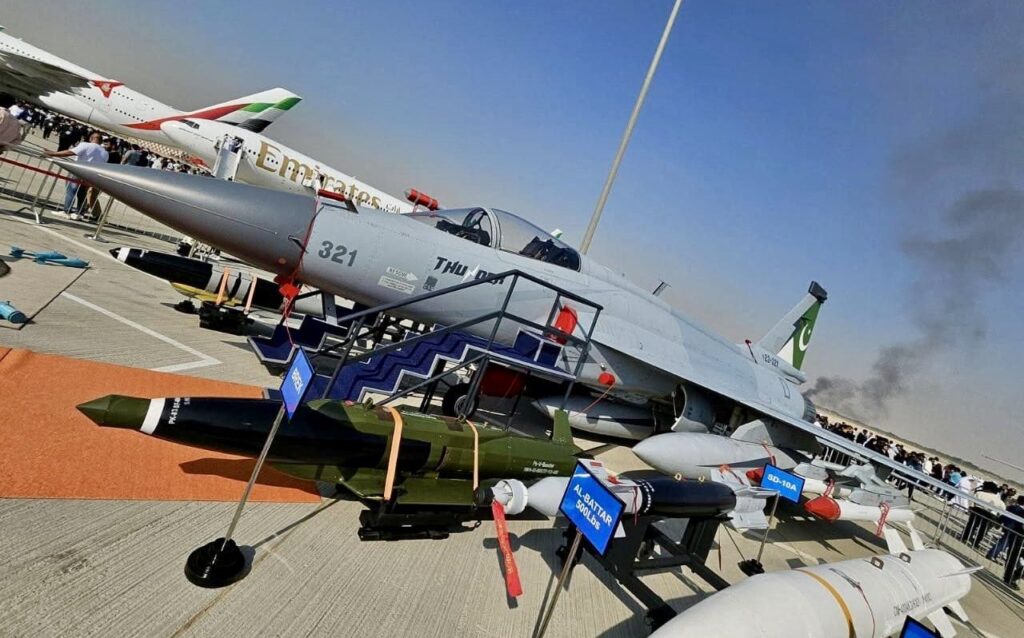
The JF-17 Thunder Block-III, the joint Sino-Pakistani fighter jet, emerged as the central narrative of strategic success at the Dubai Airshow 2025. The event was not only a commercial triumph, marked by a key new procurement MoU, but also a crucial diplomatic platform where the Pakistan Air Force (PAF) showcased its expanded capabilities and deepened global airpower alliances. The momentum was driven by the jet’s operational reputation, validated by the massive $4.6 billion Azerbaijan defense deal, and the implicit acknowledgment of its capabilities by rival military delegations.
1. PAF Deepens Global Airpower Alliances: The Diplomatic Offensive
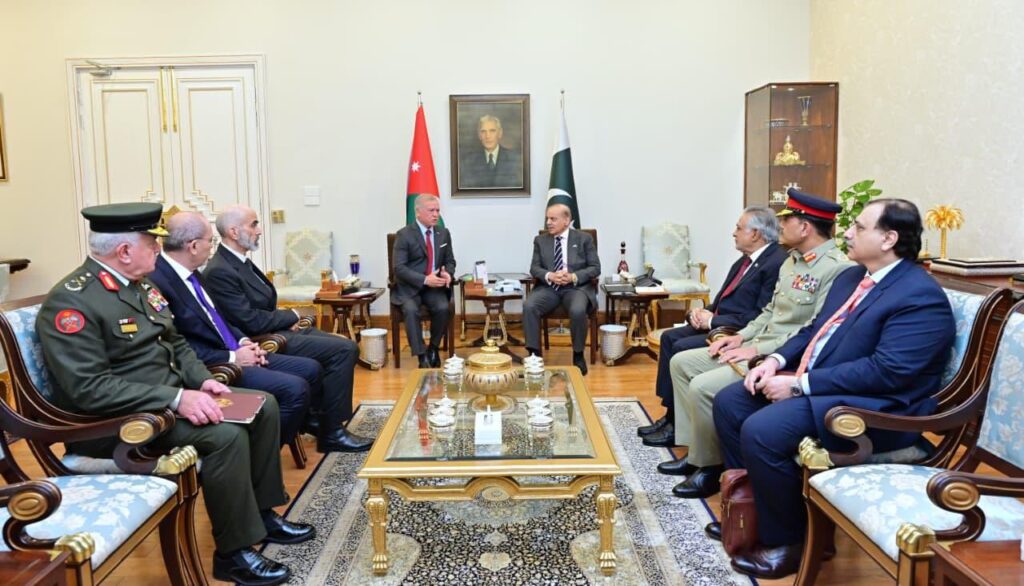
Air Chief Marshal Zaheer Ahmed Baber Sidhu, Chief of the Air Staff, led a critical diplomatic effort, holding multiple strategic engagements with senior military leaders from friendly nations, notably the UAE.
- Strategic Engagements: The Air Chief held in-depth meetings with UAE Defence Undersecretary Lieutenant General Pilot Ibrahim Nasser Al-Alawi and Commander UAE Air Force & Air Defence Major General Rashid Mohammed Al-Shamsi.
- Pillars of Cooperation: The discussions focused on bolstering defense cooperation by:
- Fostering collaboration in advanced military training.
- Exploring joint development in emerging aerospace technologies.
- Enhancing mechanisms for effective operational coordination.
- Mutual Commitment: UAE officials publicly lauded the PAF’s modernization initiatives and growing indigenous aviation capabilities, reaffirming a commitment to developing forward-looking partnerships, joint exercises, and enhanced professional exchanges.
2. Commercial Triumph: The $4.6 Billion Export Precedent
The global market interest in the JF-17 was fueled by its impressive sales record, setting a crucial precedent for Pakistan’s defense industry.
- Record-Breaking Deal: The JF-17’s success was validated by the recently confirmed defense export deal with Azerbaijan, reportedly valued at approximately $4.6 billion USD for up to 40 JF-17 Thunder Block-III fighters.
- Comprehensive Package: This contract, Pakistan’s largest-ever defense export, includes the supply of advanced equipment such as Beyond-Visual-Range Air-to-Air Missiles (BVRAAM) and precision-guided bombs, along with extensive training and logistical support, cementing a long-term military-technical partnership.
- New Procurement MoU: Building on this success, a significant Memorandum of Understanding (MoU) was signed with another undisclosed friendly country for the procurement of the JF-17, further solidifying the aircraft’s status as a top mid-tier fighter choice.
3. Operational Credibility: The “S-400 Killer” Narrative
The ISPR strategically marketed the JF-17 Block-III on its “battle-proven” operational history, using its performance in conflicts against India as a key selling point.
- 4.5-Generation Capability: The Block-III variant, equipped with an Active Electronically Scanned Array (AESA) radar and long-range munitions, offers superior capability and cost-effectiveness.
- S-400 Claim: The most compelling strategic claim was the ISPR’s assertion that the JF-17’s supersonic missiles were used to destroy the Indian S-400 missile system in Adampur during the May 2025 conflict. This claim positions the JF-17 as having an asymmetric edge and the ability to neutralize high-end Anti-Access/Area Denial (A2/AD) threats.
4. Strategic Symbolism: The Rival’s Gaze
Adding a final, potent layer of validation, the PAF pavilion became the focus of intense scrutiny from a rival military delegation.
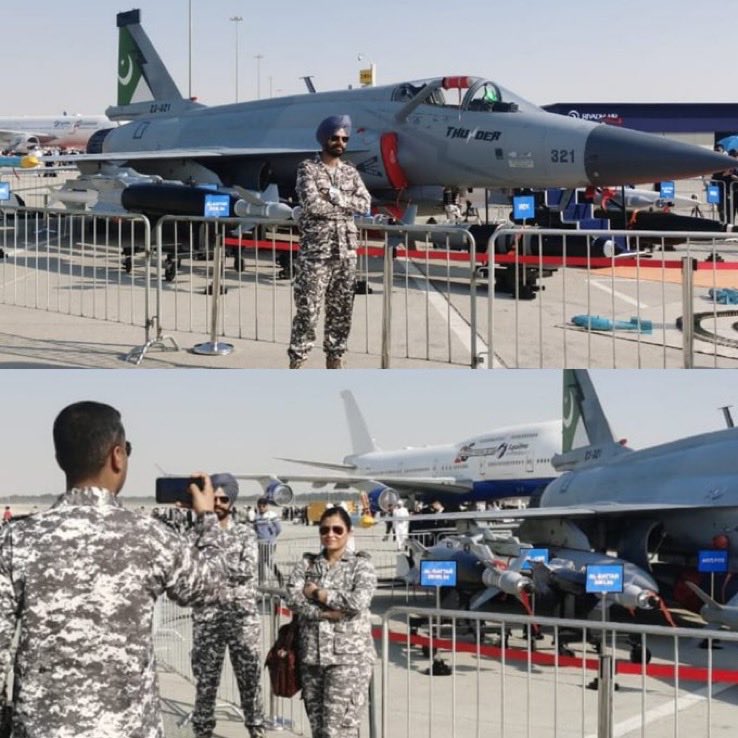
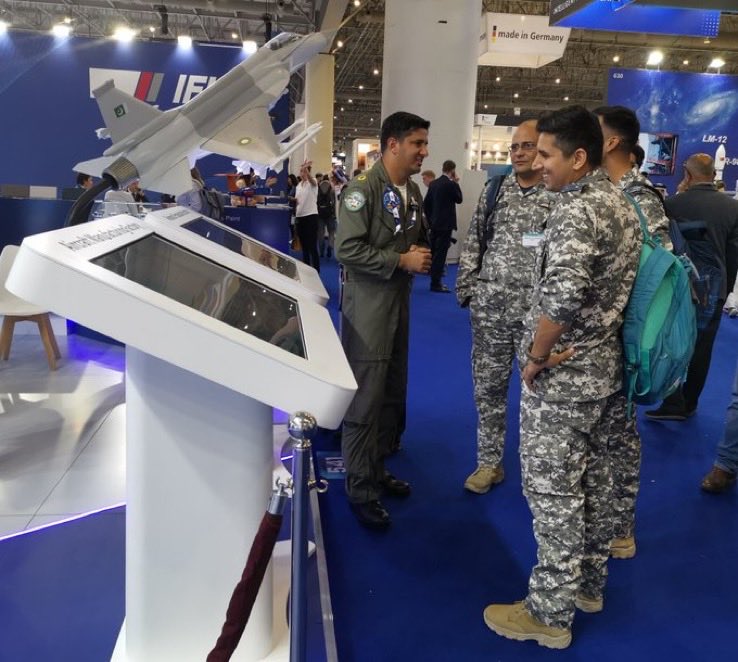
- Indian Officials’ Visit: Indian Air Force (IAF) and military personnel were reportedly seen at the PAF pavilion, closely examining the JF-17 Thunder Block-III and taking photographs with the displayed aircraft.
- Unspoken Acknowledgment: This high-profile, on-the-ground observation of the JF-17—a jet explicitly marketed as the “S-400 killer” and competitor to the indigenous Indian Tejas—is interpreted as a tacit, though professional, acknowledgment of the fighter’s technological relevance and successful operational integration. The moment underscored a complex mix of professional curiosity and underlying strategic tension between the two air forces.
Conclusion
The JF-17 Thunder Block-III’s performance at the Dubai Airshow 2025 represents a comprehensive strategic victory for Pakistan. The combination of successful defense diplomacy, culminating in deeper UAE ties and the acquisition of the $4.6 billion Azerbaijan contract, confirms the jet’s strong position in the global aerospace market. The operational claims, alongside the visible interest shown by the IAF delegation, solidify the JF-17’s image as a high-value, combat-credible platform, significantly bolstering Pakistan’s defense export portfolio and its standing in regional military dynamics.

Khalid Minhas | Editor, Diplomatic Wire
A veteran journalist with three decades of comprehensive experience, Khalid Minhas has covered politics and international relations in depth throughout his career. He has also contributed to academia, teaching journalism and mass communication as a visiting faculty member at various universities in Pakistan. He holds an M.Phil in Mass Communication and is currently a Ph.D research scholar pursuing advanced studies in the field. He is also the author of the book America, Israel aur Islam, providing insightful analysis on the subject.