PRINCE SULTAN AIR BASE, SAUDI ARABIA — Iranian missile forces struck and damaged five U.S. Air Force refueling aircraft stationed at Prince Sultan Air Base in Saudi Arabia, marking a significant escalation in the ongoing regional conflict. Official sources confirmed the strike occurred during the 14th day of “Operation Epic Fury,” a U.S.-led campaign against the Iranian regime. While the aircraft sustained substantial damage and are currently undergoing repairs, Central Command (CENTCOM) reported no American fatalities in this specific incident.
Geopolitical Significance: The Nut Graf
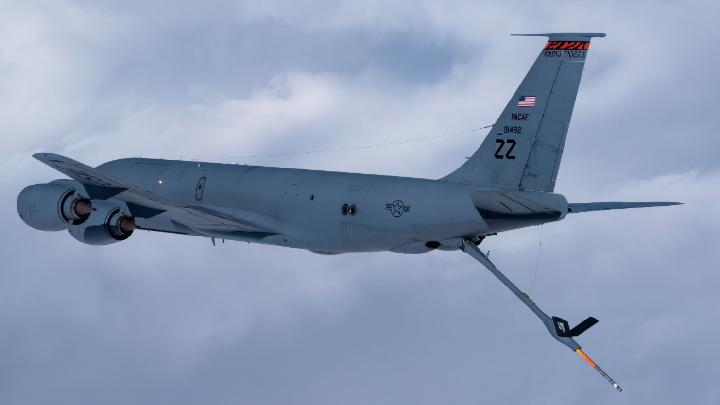
The precision strike on aerial refueling assets targets the “connective tissue” of U.S. power projection in the Middle East. By damaging the tanker fleet, Tehran aims to degrade the operational range of B-2 and F-35 sorties striking deep within Iranian territory. Furthermore, the timing of the strike coincides with President Donald Trump’s aggressive “Maximum Pressure 2.0” military posture, signaling that despite heavy bombardment of its own infrastructure, the Islamic Revolutionary Guard Corps (IRGC) maintains the capability to disrupt U.S. logistics across the Persian Gulf.
Escalation at Kharg Island and Strategic Strikes
According to reports from the White House and CENTCOM, the U.S. military has intensified its campaign against Iranian high-value targets. President Donald Trump recently announced that U.S. forces successfully “obliterated” military installations on Kharg Island, Iran’s primary oil export hub.
Official statements from the Pentagon emphasized:
- Target Selection: Strikes were limited to military and security infrastructure to spare civilian oil production capabilities, though global markets remain volatile.
- Leadership Casualties: Secretary of Defense Pete Hegseth stated that Iran’s new Supreme Leader, Mojtaba Khamenei, was likely wounded in recent precision strikes on Tehran.
- Attrition Rates: CENTCOM reports a 23% decrease in Iranian ballistic missile launches over the last 24 hours, suggesting the air campaign is successfully degrading Tehran’s offensive launch sites.
The “Iceland” Discrepancy: Fact-Checking the Record
While reports have circulated regarding a “strike at Iran Iceland,” current diplomatic cables and military briefings from the UN and CSIS confirm no such geographic entity exists within the Iranian theater. It is highly probable that these reports refer to Kharg Island, the strategic “crown jewel” of Iranian maritime energy logistics, which has been the focus of recent heavy bombardment by U.S. and Israeli forces. There is no verified evidence of military operations involving the nation of Iceland in this conflict.
Strategic Outlook
The current trajectory of Operation Epic Fury suggests a shift from strategic degradation to potential regime destabilization. - Logistical Constraints: The damage to five U.S. refueling planes may temporarily slow the tempo of long-range bombing missions, forcing CENTCOM to rely on carriers or regional allies for mid-air support.
- Maritime Security: Continued IRGC attempts to mine the Strait of Hormuz pose a direct threat to the CPEC trade corridor and global energy prices, likely prompting a surge in international naval patrols.
- Diplomatic Vacuum: With the failure of the Muscat indirect talks in February 2026, a diplomatic off-ramp remains unlikely as the Trump administration prioritizes “Peace Through Strength” over negotiated settlements.

Khalid Minhas | Editor, Diplomatic Wire
A veteran journalist with three decades of comprehensive experience, Khalid Minhas has covered politics and international relations in depth throughout his career. He has also contributed to academia, teaching journalism and mass communication as a visiting faculty member at various universities in Pakistan. He holds an M.Phil in Mass Communication and is currently a Ph.D research scholar pursuing advanced studies in the field. He is also the author of the book America, Israel aur Islam, providing insightful analysis on the subject.